

It is amazing to see an upside-down fig tree growing from the roof of an old ruin in Italy. Epiphytic growth refers to a type of growth when a tree grows on another plant or structure without becoming a parasite.
In this instance, the ancient ruin’s roof is covered with soil and trash where the fig tree has grown. The tree is firmly planted thanks to the roots that have grown around the roof’s stones and cracks over time.

The tree is probably growing upside-down since there isn’t much light on the roof, which makes it grow toward the light. The fig tree will have branches and leaves that drop down to the ground, giving it a lovely and distinctive appearance.
This fig tree’s development may have ecological advantages in addition to being aesthetically pleasing to the surroundings. The structure of the old ruin can be stabilized by the tree’s roots, limiting further erosion and damage. The figs that the tree produces can serve as a source of food for the local species.

Overall, the upside-down fig tree growing from the roof of an ancient ruin in Italy is a testament to nature’s ability to adapt and thrive in unexpected places.


The true story of Josephine Myrtle Corbin, the lady born with four legs and two private parts
Josephine Myrtle Corbin, an American sideshow performer born in 1868, had a rare condition known as dipygus, which caused her to have four legs, each smaller inner leg paired with one of her outer legs. Corbin joined the sideshow circuit, captivating audiences as the "Four-Legged Girl from Texas."

Pierre Brassau: The chimpanzee painter who deceived the avant-garde world
Abstract paintings by a previously unknown artist “Pierre Brassau” were exhibited at a gallery in Sweden, earning praise for his “powerful brushstrokes” and the “delicacy of a ballet dancer”. None knew that Pierre Brassau was actually a 4 year old chimp from the local zoo.

The Heartbreaking Story Of Ella Harper, The ‘Camel Girl’
Ella Harper, Professionally known as the “Camel Girl” was born with a rare orthopedic condition that cased her knee to bend backward. Due to this condition, had to walked on all four legs, which resulted in her nickname as “Camel Girl”. Tough it was hard at first, but soon she made a fortune out of it.

Roller Coasters were First Invented to Distract People from sin
Roller coasters were invented to distract Americans from sin. In the 1880s, hosiery businessman LaMarcus Thompson didn’t like that Americans were going to places like saloons and brothels and created the first roller coaster on Coney Island to persuade them to go there instead.

In 1954, an Extraterrestrial Bruiser Shocked This Alabama Woman.
In the year 1954, a grapefruit sized meteorite crashed through the roof of a farm house in Alabama, bounced off a large wooden console radio and hit Ann Hodges while she was napping on her couch. This was the first confirmed case of a person to be hit by a meteorite.


A man who has been suffering from headaches for nearly six months discovers chopsticks lodged in his brain
When it was discovered that a Vietnamese man with headaches and vision problems had chopsticks lodged in his brain, the doctors were almost as surprised as the man himself.

The Story of Tsutomu Yamaguchi: The Man Who Survived Both Atomic Bombs
Tsutomu Yamaguchi’s story is one of astonishing survival and resilience. In August 1945, while on a business trip in Hiroshima, he endured the catastrophic atomic bombing and, unbelievably, survived to return to his home city of Nagasaki—only to face a second atomic attack days later. Officially recognized as the only person to survive both bombings, Yamaguchi’s life is a powerful testament to human courage, hope, and the devastating impact of nuclear warfare.

Jack the Baboon operated a railroad, earned a living, and never made a mistake
A baboon worked as a signalman for the railroad in the late 1800s. He never made a mistake and worked for the railroad until the day he died.

Inspirational Journey of Billy Owen From Cancer Patient to Zombie Actor
A man called Billy Owen lost an eye and half of his face to cancer and used it to start a career as a zombie actor.

A woman finds her ex-boyfriend living in her attic 12 years after they broke up
Most people have heard of "things that go bump in the night," but for one South Carolina lady, that "thing" was her ex-boyfriend, whom she discovered living in her attic more than 12 years after they broke up.

The Miracle Baby: Nigerian Couple in the UK Welcomes a Rare Blonde, Blue-Eyed Child
A black, Nigerian couple living in the U.K. gave birth to a white, blonde, blue-eyed baby that they call the "miracle baby."

What Caused The Mysterious Patomskiy Crater in Siberia?
Discovered in 1949, the Patomskiy Crater resembles a huge convex cone with a funnel-shaped recess and a rounded hill in the middle, which looks like an eagle’s nest with an egg nestled inside it. The crater’s origin is a mystery that has baffled scientists for decades.

Atomic Tourism: In the 1950s, nuclear tests in Las Vegas served as a draw for tourists
Between 1950 and 1960, Las Vegas offered “Atomic Tourism” in which guests could watch atomic bombs being tested in the desert as a form of entertainment.

Poto And Cabengo: The Secret Language Of Twins
Poto and Cabengo, as the two girls called each other, communicated in their own language. The twins were ignored by their parents and secluded from the outside world because their father felt they were developmentally retarded, and their unique language evolved as a result of that neglect.

Recipient of suicide victim's heart kills himself 12 years later
In 1995, Sonny Graham received a transplanted heart from a suicide victim. He then committed suicide in the very same manner as the donor.

This Yogi Spent 76 Years Without Eating or Drinking Anything and Confirmed by
Prahlad Jani, the starving monk who lived 76 Years without food and water.
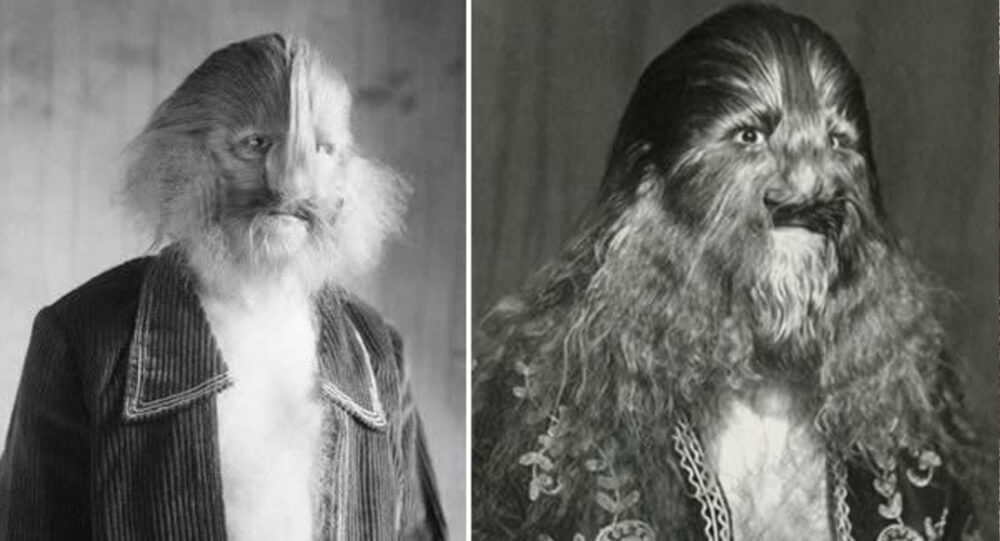
The story of Lionel the Lion-Faced Man, Stephan Bibrowski
Stephen Bibrowski, also known as Lionel the Lion-faced Man, was a well-known sideshow entertainer. His entire body was covered in long hair, giving him the appearance of a lion; this was most likely due to a rare condition known as hypertrichosis. Lionel traveled to the United States in 1901 and began performing with the Barnum and Bailey Circus.

The mysterious Pumpkin impaled on the top of Tower
Twenty Three years ago, somebody impaled a 60-pound pumpkin 170 off the ground on this spire at Cornell University. Nobody knows who did this or how they did it.

Belgian Woman Banned from Zoo After 4-Year Affair with Chimpanzee
A Belgian woman was banned from the zoo after having an affair with a chimp.

The “Walking” Palm, tree species can walk up to 65 feet each
This tree species can walk up to 65 feet each year to find the best habitat to live in.

Mom Cries After Seeing Her Deceased Daughter in Virtual Reality
Jang Ji-Sung lost her 7-year-old daughter to haemochromatosis in 2017, a rare disorder in which the body absorbs too much iron. The two reunited through the use of virtual reality technology.

Mystery SOLVED: blood Rain in India
The dissemination of spores of microalgae has been identified as the origin of the 'Blood Rain' phenomena, according to a new study by Indian and Austrian experts. Since 1896, reports of intermittent red-colored rain in portions of Kerala and Sri Lanka have been coming in. The most recent one occurred in 2013 over Kerala.

The Google Maps Discovery: the Mystery of William Moldt's Disappearance
In 2019, Google Maps helped solve the decades-old mystery of William Moldt, who disappeared in 1997. A former resident spotted his submerged car in a retention pond while using Google Earth. The vehicle, visible since 2007, contained Moldt's skeletal remains, providing closure to his case.

The Mystery of Canada's Magical Spotted Lake
Lake Khiluk, the world's most mineralized lake, and one of the most mysterious places on Earth. Each of these spots has a distinct chemical content and is said to cure various diseases.

Lucy and Maria The Biracial Twin Sisters with Rare Black and White Skin Colours
Lucy and Maria Aylmer are twins, but they have a hard time to convincing people. Even though they have mixed-raced parents, their mom was still shocked when the midwife handed her babies she’d expected to look alike, but were complete opposite.