
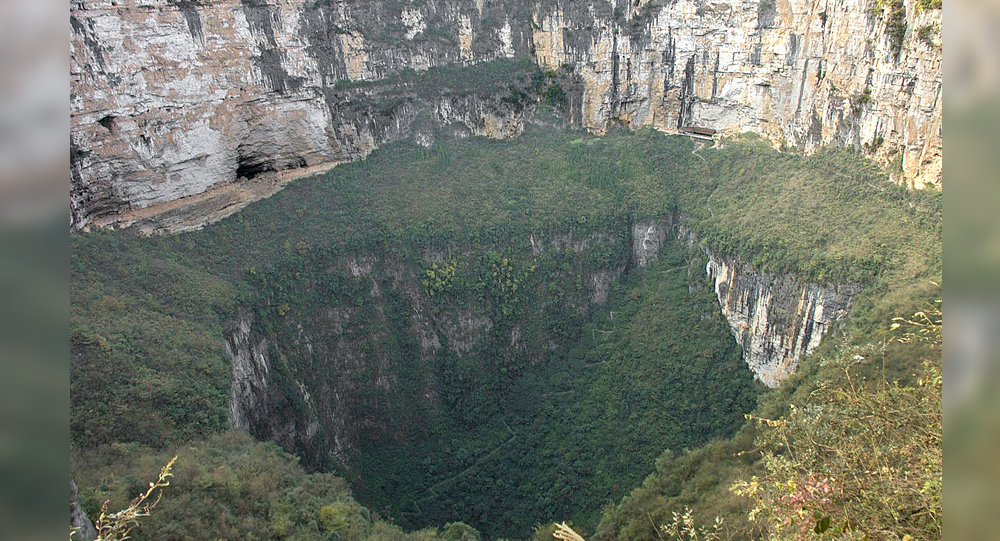
Xiaozhai Tiankeng, also known as the “Heavenly Pit,” redefines the scale of natural sinkholes. Located in Fengjie County, Chongqing Municipality, China, it measures approximately 626 meters (2,054 feet) long, 537 meters (1,762 feet) wide, and plunges between 511 and 662 meters (1,677 to 2,172 feet) deep—making it the deepest and largest known sinkhole on Earth.
To put this into perspective, the pit’s depth is nearly twice the height of the Empire State Building. The opening covers an area of about 274,000 square meters, approximately equivalent to 38 soccer fields. Such immense scale gives Xiaozhai Tiankeng a unique place in geological and natural history.
The Double-Nested Structure: Two Bowls in One Giant Pit
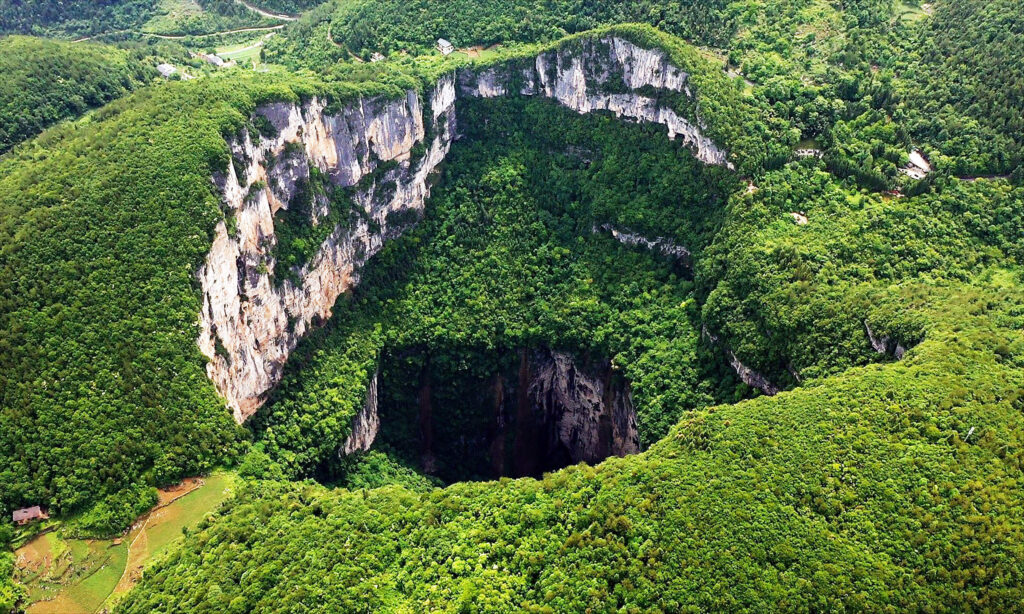
Xiaozhai’s striking geology features a double-nested structure, meaning the sinkhole consists of two distinct “bowls” or steps, separated by a large sloping ledge formed by soil trapped in the limestone.
The upper bowl descends roughly 320 meters (1,050 feet), while the lower bowl plunges an additional 342 meters (1,122 feet). The diameter of each bowl averages between 257 and 268 meters (843 and 879 feet), highlighting the sinkhole’s complexity.
This nested arrangement reflects the process of progressive limestone erosion and collapse over tens of thousands of years, representing a spectacular example of karst topography—a landscape shaped by the dissolution of soluble rocks.
Geological Origins: Water and Time as Sculptors
Xiaozhai Tiankeng formed over the Difeng cave system, carved out through relentless erosion by an underground river. This subterranean river begins in Tianjin fissure gorge, flowing about 8.5 kilometers (5.3 miles) underground before plunging out at the sinkhole’s base as a majestic 46-meter (151-foot) waterfall that feeds the Migong River.
Over an estimated 128,000 years, acidic rainwater and groundwater dissolved limestone bedrock, creating underground voids. When the cavern ceilings could no longer withstand their weight, they collapsed repeatedly, enlarging the sinkhole and carving out the impressive double-bowl shape seen today.
The median annual flow rate of the subterranean river is about 8.77 cubic meters per second but can surge to 174 cubic meters per second during rainy seasons, accelerating erosion and shaping this geological marvel.
A Hidden Ecosystem: Flora and Fauna in the Pit
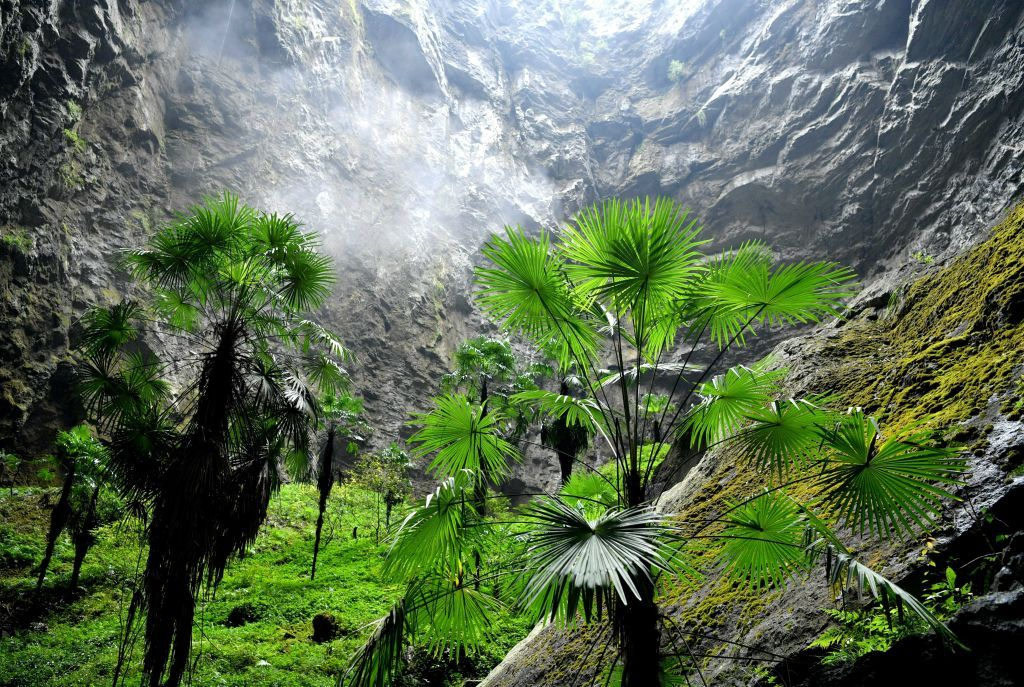
Despite its immense depth and vertical walls, Xiaozhai Tiankeng shelters a remarkable biodiversity. Scientists have identified more than 1,285 plant species within the pit, including ancient species like ginkgo trees—a “living fossil” dating back millions of years.
Animal life thrives as well. Rare species such as the elusive clouded leopard and the endangered Chinese giant salamander inhabit the sinkhole’s microclimates, benefiting from its seclusion from human disturbance.
The “Heavenly Pit” thus functions like a natural biosphere, preserving pockets of ancient and rare life forms in a vertical, enclosed environment.
Discovery by the Outside World and Scientific Expeditions
Although locals have long known about the pit, the outside world “discovered” Xiaozhai Tiankeng only in 1994, when British and Chinese speleologists attempted detailed exploration and mapping.
Despite rigorous efforts, navigating its underground river systems proved extraordinarily difficult. Over a decade, multiple expeditions mapped portions of the cave but were stopped by strong currents and submerged passages. Thus, much of Xiaozhai’s subterranean mysteries remain unexplored.
Researchers also used advanced 3D laser scanning and drone technology to measure and visualize the vertical cliffs and internal structure, enabling better understanding while minimizing human risk.
Visiting Xiaozhai Tiankeng: Tourism Meets Nature
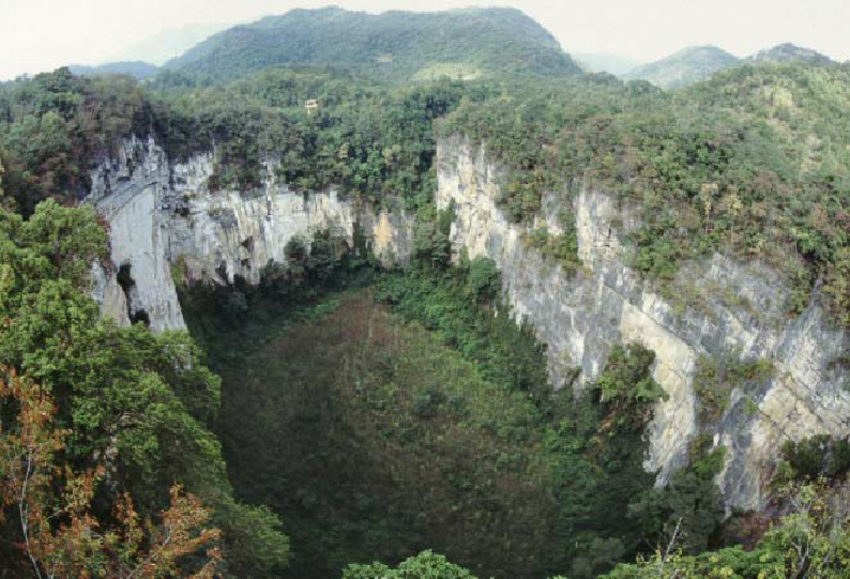
Today, a 2,800-step staircase allows adventurous tourists to descend into the rim of the pit to appreciate its vast scale and breathtaking views. The surrounding region supports several ecotourism ventures, leveraging the sinkhole’s allure.
Visitors can witness, especially during the rainy season, spectacular waterfalls cascading into the maw of the Earth, watch unique flora bloom along the steep walls, and explore trails surrounding this geological wonder.
Despite tourism, conservation efforts emphasize protecting the fragile ecosystem inside the sinkhole from human impact, balancing access with preservation.
Fascinating Trivia About Xiaozhai Tiankeng
- Xiaozhai Tiankeng literally means “Little Village Heavenly Pit,” named after a nearby abandoned settlement.
- It is the largest sinkhole by volume in the world at about 119 million cubic meters.
- Some vertical walls reach heights that make rappelling and rock climbing challenging for even the most experienced adventurers.
- The underground river beneath the sinkhole has a height drop of 364 meters over its 8.5-kilometer course, producing strong flow rates.
- Ginkgo trees inside the sinkhole represent species dating back over 200 million years to the Triassic era.
- Cave pearls, smooth polished stones, have been discovered inside the pit’s caverns, formed over centuries.
- The “Heavenly Pit” pools a microclimate, allowing species to survive at depths despite surface aridity.
- Large sinkholes like Xiaozhai likely formed due to a combination of tectonic activity and chemical erosion over geological timescales.
The Geological and Ecological Importance of Xiaozhai Tiankeng
In addition to its status as a record-breaking natural sinkhole, Xiaozhai Tiankeng offers critical insights into earth’s geological history, karst processes, and underground water systems.
Understanding such formations helps scientists study groundwater flow, rock stability, and climate effects over millennia. Ecologically, Xiaozhai is a natural laboratory for studying isolated ecosystems and species conservation in extreme, enclosed environments.
Its preservation is vital for sustained scientific research and fostering global awareness of unique karst landscapes threatened by development and climate change.
Final Thoughts: Entering the Earth’s Majestic “Heavenly Pit”
Xiaozhai Tiankeng captivates with its sheer size, geological complexity, and ecological richness. It offers a rare glimpse into deep Earth processes and the tenacity of life in isolated natural marvels.
By exploring this immense sinkhole, scientists, adventurers, and nature lovers alike connect with the planet’s dynamic forces and biodiversity, reminding us of the hidden wonders beneath our feet.
If Xiaozhai’s stunning tale of geology and life inspired awe, share this article to illuminate one of Earth’s greatest subterranean treasures.
Sources & Further Reading:
- Wikipedia: Xiaozhai Tiankeng (2013)
- IFLScience: China’s Xiaozhai Heavenly Pit, Deepest Sinkhole (2023)
- BBC Travel: Xiaozhai Tiankeng, The World’s Biggest Sinkhole (2022)
- National Park Service: Karst Landscapes and Sinkholes
- ScienceAlert: Massive Sinkholes and Cave Complexes in China (2018)

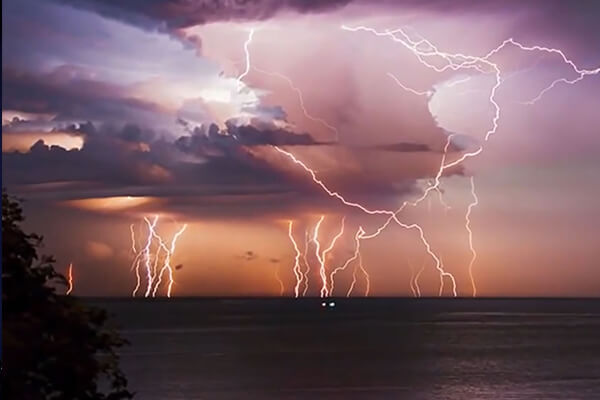
8 most amazing natural phenomena on earth
Nature is elusive and unpredictable, and the unexplained manifestations of its influence often leave us speechless. Though you might believe that shifting rocks and blood-colored rain are a prank or a magical phenomenon, science has an explanation for (almost) anything.

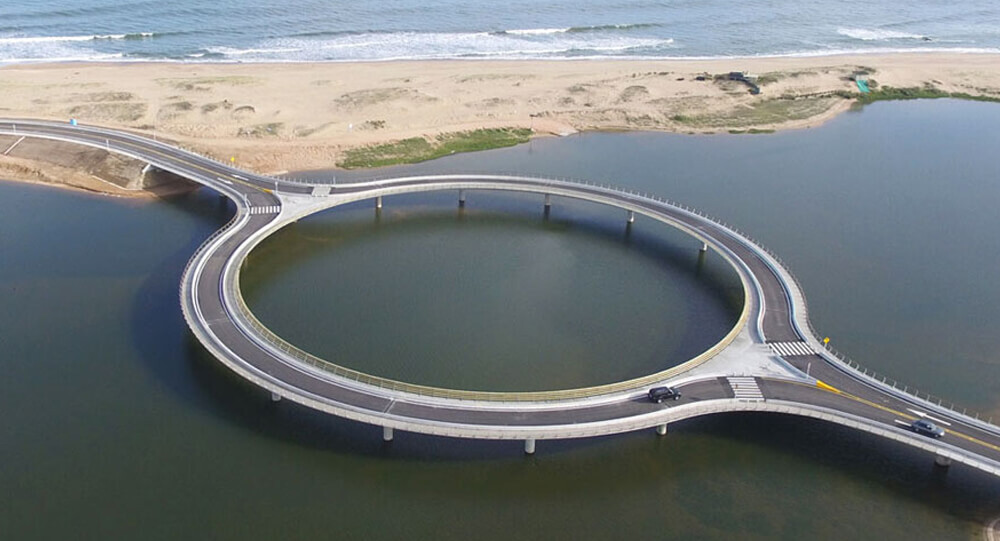
Circular Bridge Built To Slow Down Drivers So That They Would Enjoy The View (Photos)
Uruguay’s Laguna Garzon Bridge splits into a circle so drivers can slow down and enjoy the view. It also prevents head-on collisions and creates a walkway for pedestrians.
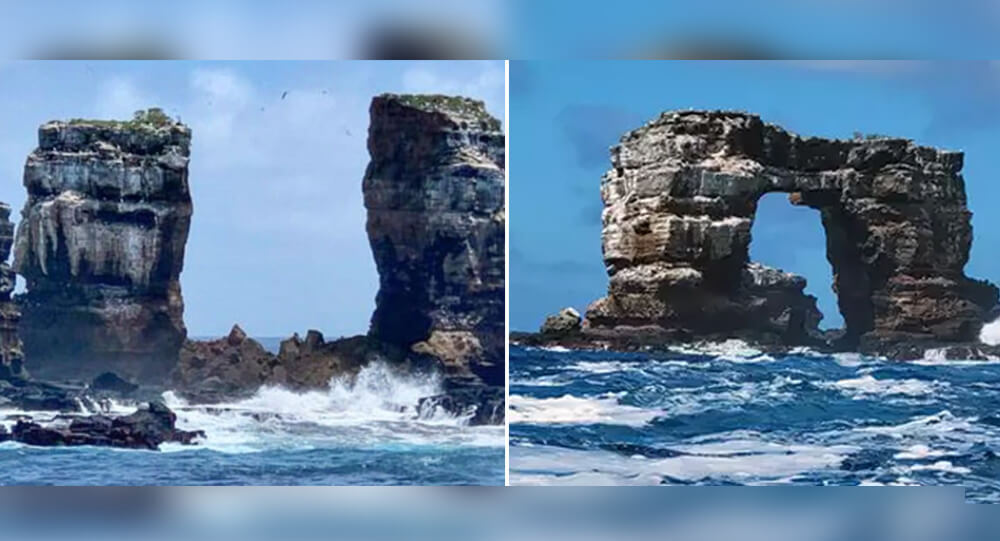
Darwin's Arch collapse
According to news sources, the top of Darwin's Arch, a famous natural stone archway in the northern Galapagos Islands, has collapsed into the waves.
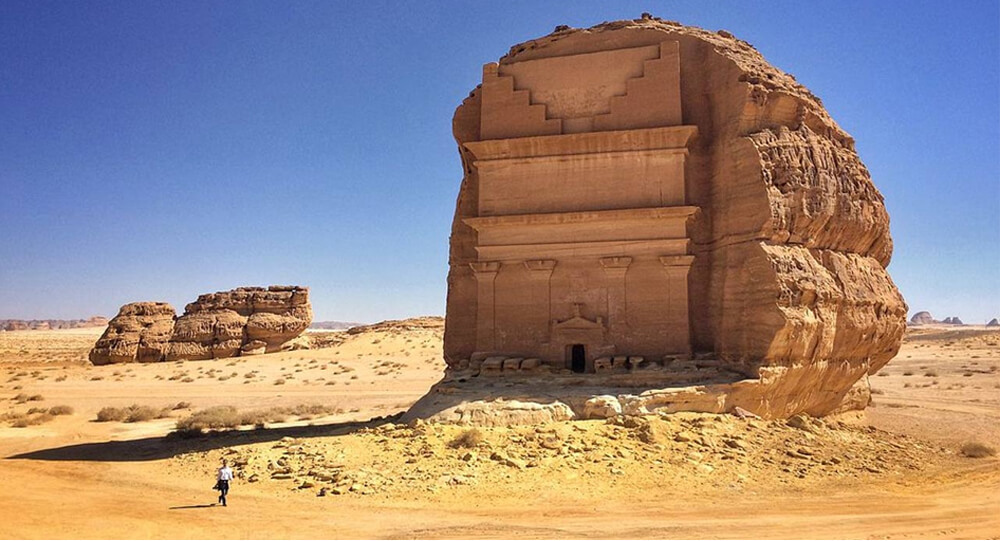
Qasr al-Farid, the Lonely Castle of the Nabataeans
The remote tomb of Qasr al-Farid, situated in the Saudi Arabian desert, dates back to the 1st Century CE. It was built by the Nabataean people, who also built Petra in Jordan. This site has remained largely undisturbed.
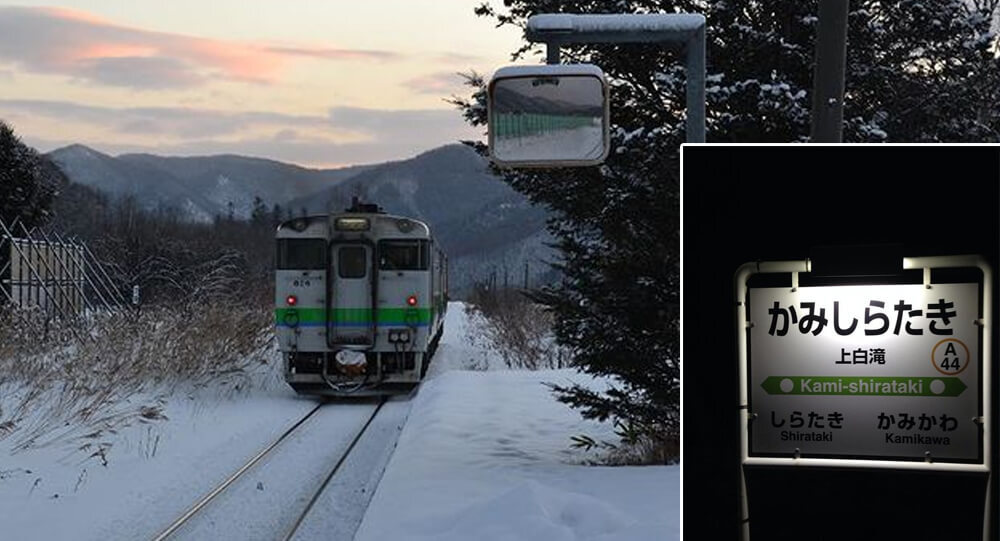
This soon-to-be-closed train station in Japan only serves one passenger
Japan keeps a defunc train station operational in 2015 for the sole purpose of allowing one girl to go to school every day. Only two stops are made by the train: once when an only one high school student departs for school and once when she returns.

Sandy Island: The Phantom Island That Fooled Maps and Google Earth for Centuries
Sandy Island, charted since 1774, was long considered a phantom island in the Coral Sea. Despite appearing on maps and Google Earth, it was "undiscovered" by scientists in 2012, revealing only deep ocean instead of land. The island's existence was likely a cartographic error or a misidentified pumice raft.
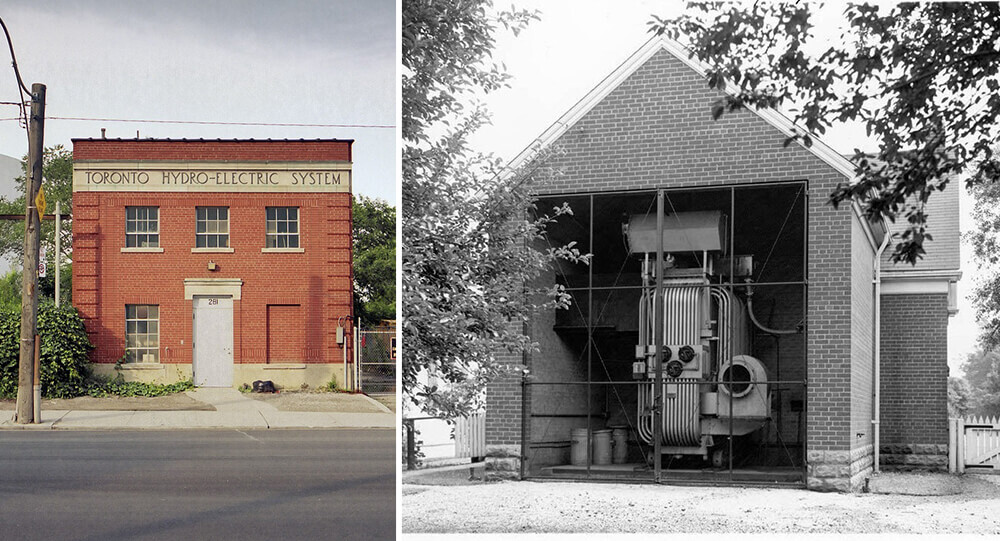
Toronto’s Camouflaged Electric Substations
For over a century, Canada’s second-largest power company has been disguising its electrical substations in Toronto as beautiful houses that blend perfectly with the neighborhood. These fake houses contain transformers that supply electricity throughout the city.
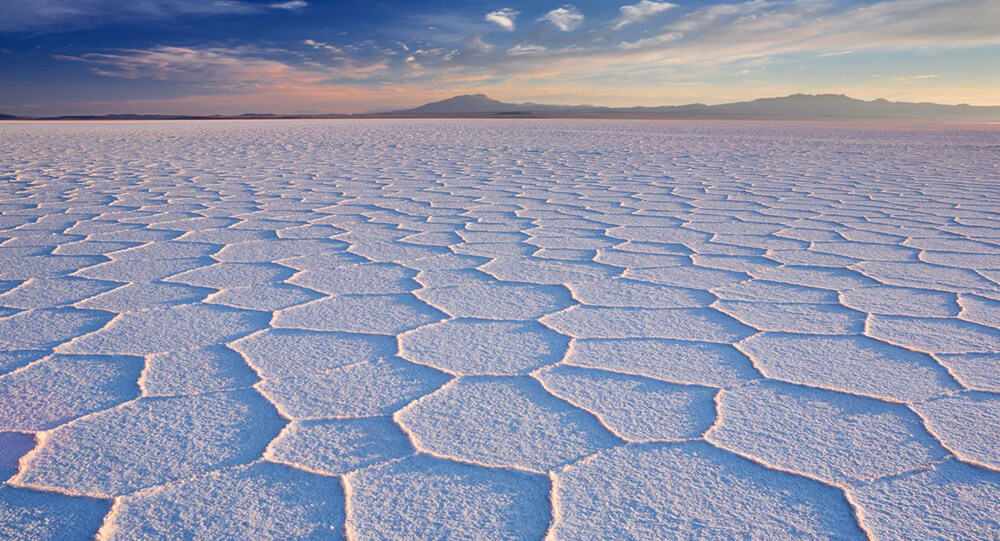
The world's largest salt flat, can be seen in space
At 10,582 square kilometers (4,086 sq mi), the Salar de Uyuni (or Salar de Tunupa) is the largest salt flat in the world. It is located in the Potosi and Oruro departments in southwest Bolivia, near the crest of the Andes, and is elevated 3,656 meters (11,995 ft) above the mean sea level.
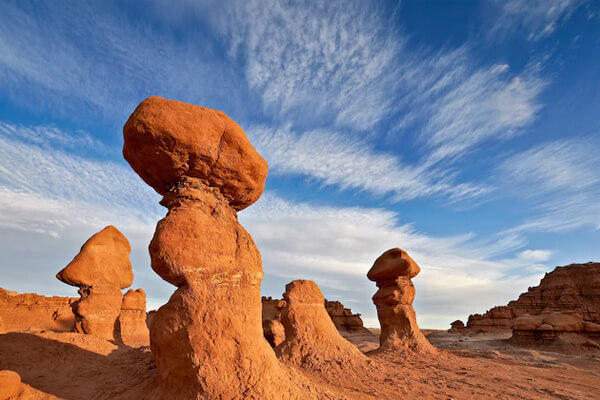
11 Amazing and famous rock formations around the world
For many years, people have been attracted to these spectacular-looking boulders because of their shape, components, location, or picturesque surroundings. Many of them are massive, and seeing them is an amazing experience.
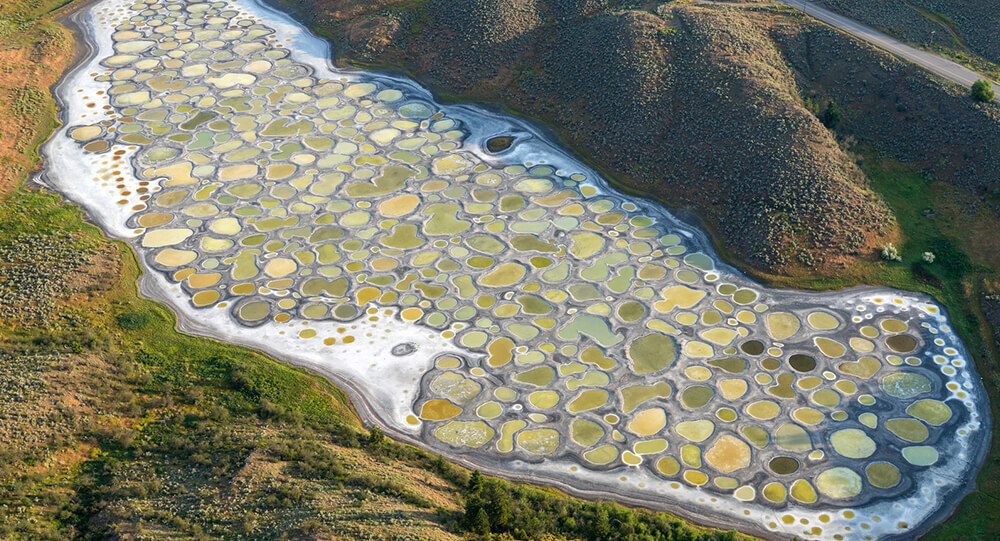
The Mystery of Canada's Magical Spotted Lake
Lake Khiluk, the world's most mineralized lake, and one of the most mysterious places on Earth. Each of these spots has a distinct chemical content and is said to cure various diseases.
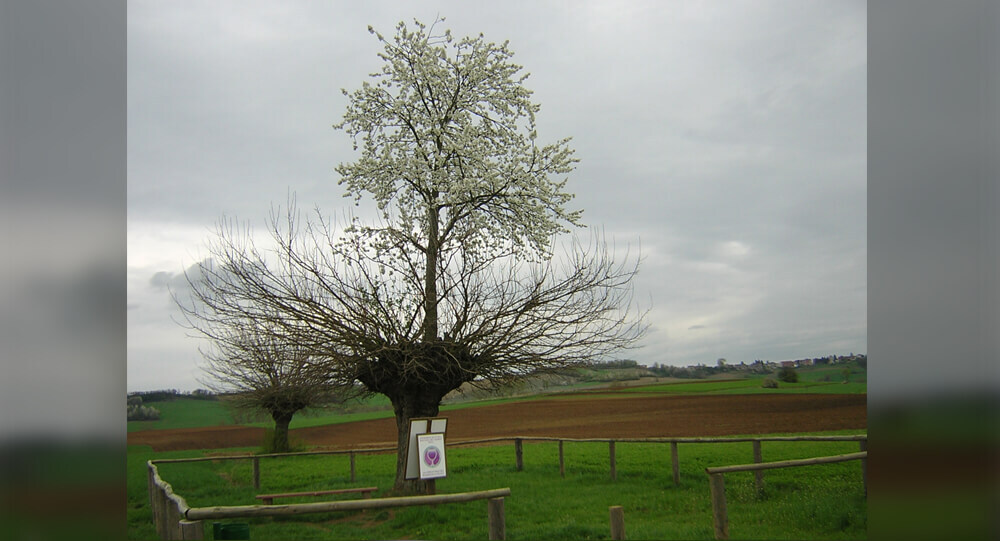
The Unique Grana Double Tree of Piedmont, Italy
The “Grana Double Tree” in Piedmont, Italy is a highly unusual tree, which consists of a cherry tree growing atop a mulberry tree. It is essentially a two-species, two-tiered hybrid duplex.

Coolest and unique international boarders you must see
Not only do borders define us, but they also determine who we are. Simple lines on the ground, either man-made or geological, distinguish one culture from the next.
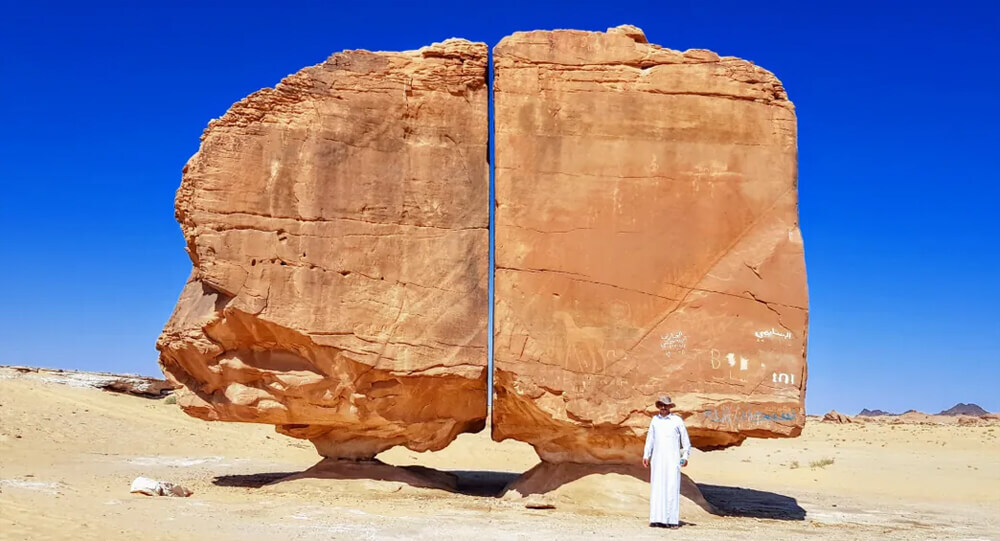
How Were the Two Parts of the Al Naslaa Rock Formation Created?
Scientists have been puzzled by the Al Naslaa rock formation in Saudi Arabia for a long time, and there is still no explanation for why this boulder appears to have a precise incision across the middle of it.
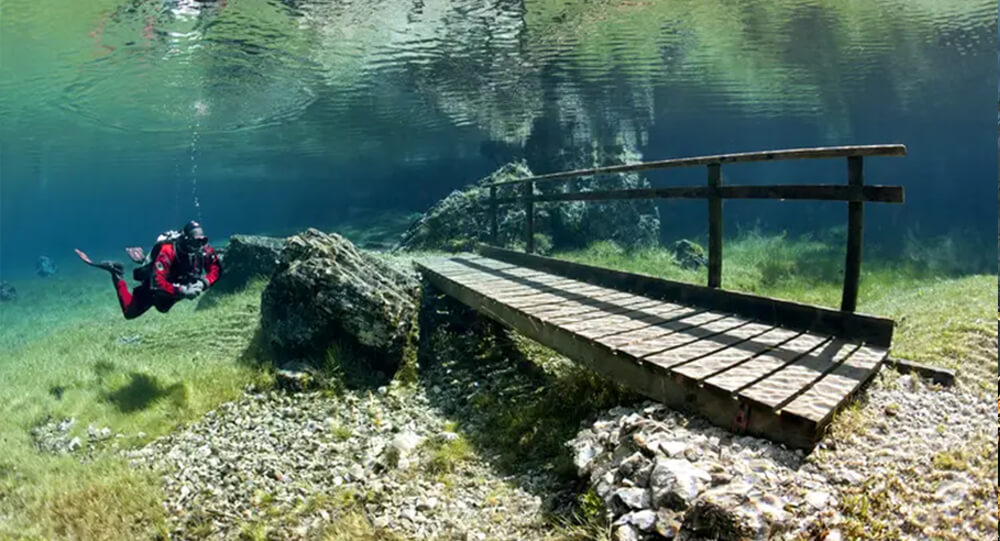
Grüner See, The Park That Turns Into A Giant Lake Naturally
There is a place in Austria called Grüner See which is a dry park in winter and turns into a 12-meter-deep lake in summer.

How Migratory Birds Navigate Thousands of Miles Without Getting Lost
Migratory birds undertake epic journeys spanning thousands of miles with astonishing precision, never losing their way. Their secret lies in a remarkable blend of innate senses, learned experience, and sophisticated navigation tools—ranging from the Earth's magnetic field to celestial clues and mental maps. Explore how these feathered travelers accomplish one of nature's most astounding feats through science, intuition, and adaptation.
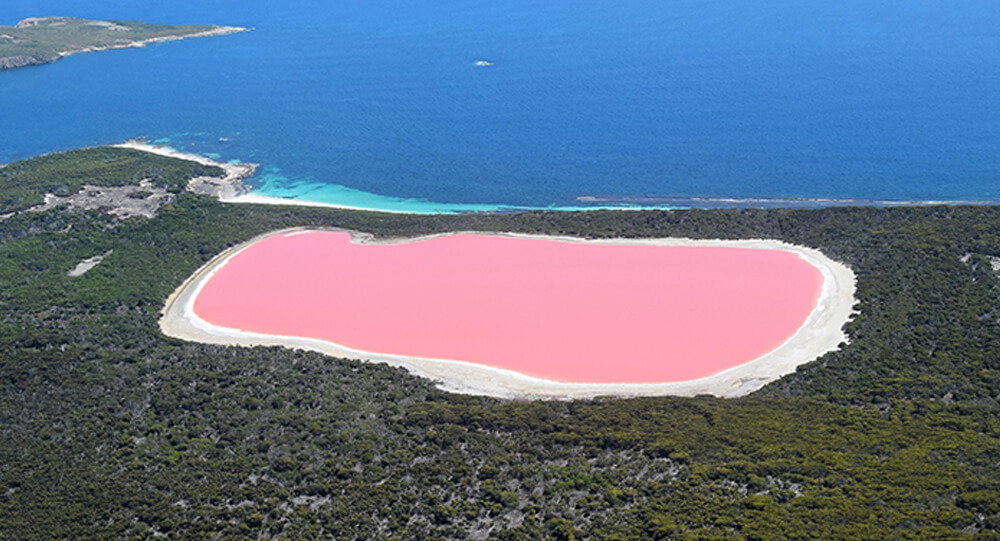
What is secret behind the Australia’s mysterious pink lake?
Lake Hillier in Australia maintains a bright pink hue all year round. Although no one knows for sure what causes the unique coloring, experts speculate that it might be the result of high salinity, a pink bacteria called “halobacteria,” and a salt-loving algae species called Dunaliella salina.
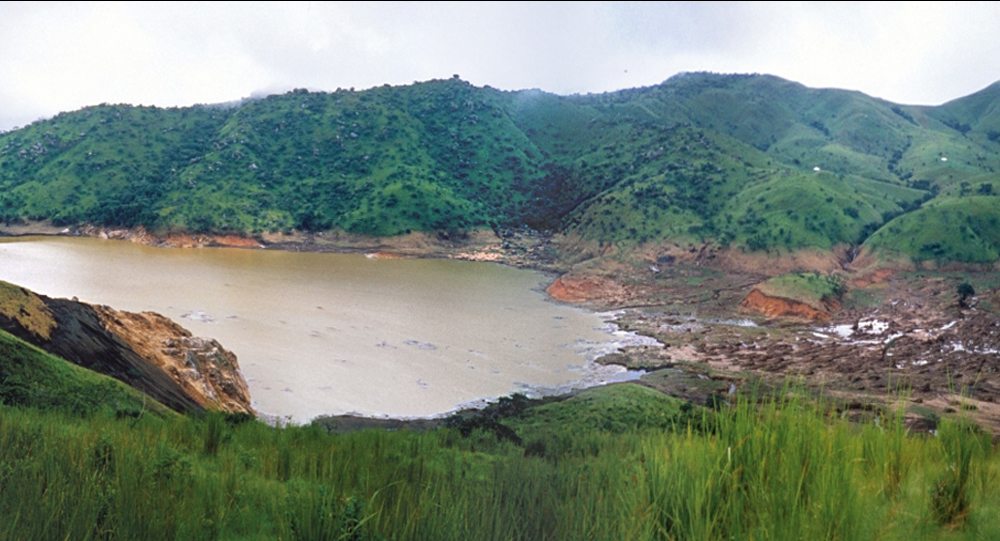
The Lake That Explodes: The Deadly Mystery of Africa’s Silent Killer
Did you know some lakes can kill without warning? Lake Nyos in Cameroon once erupted with invisible carbon dioxide, suffocating 1,700 people in minutes. These rare “exploding lakes” silently build pressure, turning still waters into deadly, unseen assassins.
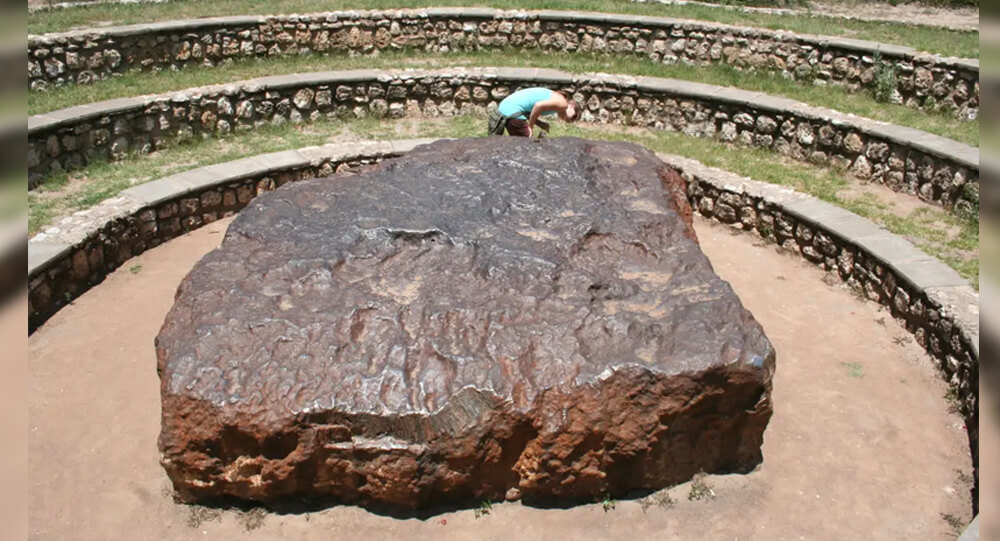
Top 6 Largest Meteorites Ever Found on Earth
When space meteorites hurtle towards Earth, they frequently burn up in the atmosphere before reaching us. Those that burn up become meteors - or shooting stars.
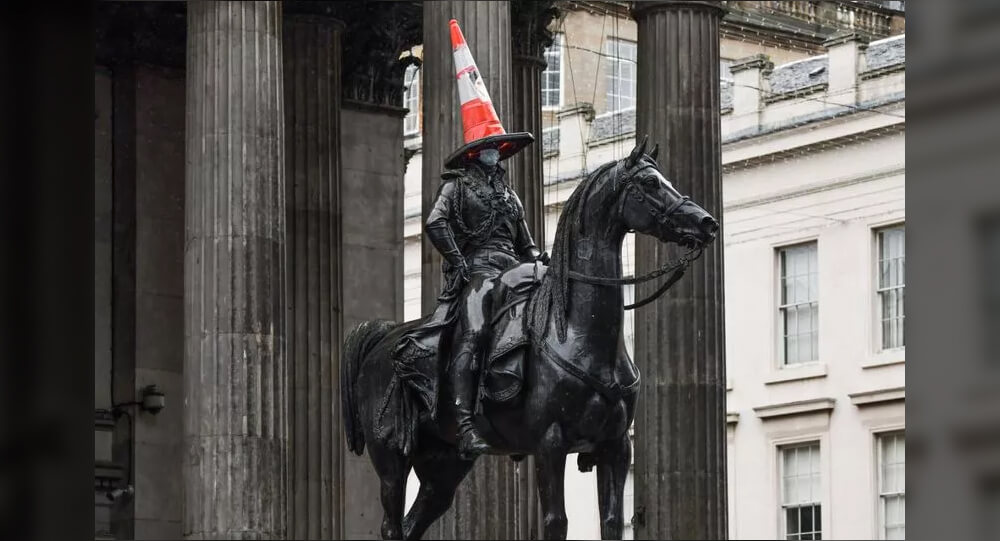
The story behind Glasgow's iconic Duke of Wellington statue and its well-known traffic cone hat
The city of Glasgow spends approximately £10,000 every year to remove traffic cones from the head of the Duke of Wellington statue. The Duke of Wellington statue, which first appeared in the early 1980s, has worn an orange traffic cone hat for decades. but how did it get there - and more importantly how did it stay?

How European Rabbits Took over Australia
In 1859, wealthy settler Thomas Austin released 13 wild rabbits on his Australian estate. By 1920, their population grew to 10 billion.
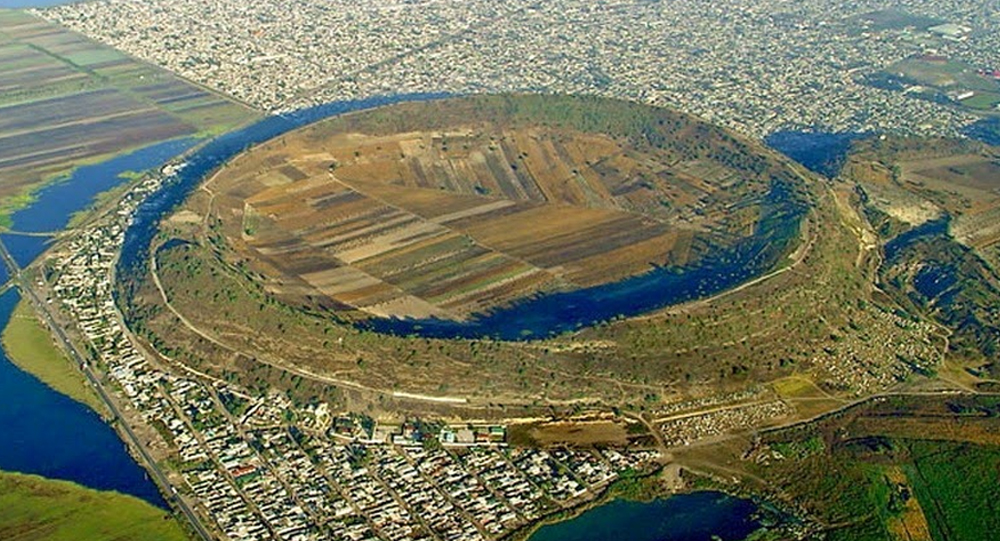
How Xico in Mexico Transformed from Volcano to Lake to Farmland
Xico, located near Mexico City, has a fascinating geological and cultural history that tells a story of transformation—once a violent volcano, then a serene lake, and today a fertile expanse of farmland. This transformation reflects the dynamic forces of nature and human intervention over centuries. This article explores the journey of Xico’s volcanic crater from its fiery origins through its time as a lake and how it ultimately became rich soil supporting agriculture and community life.
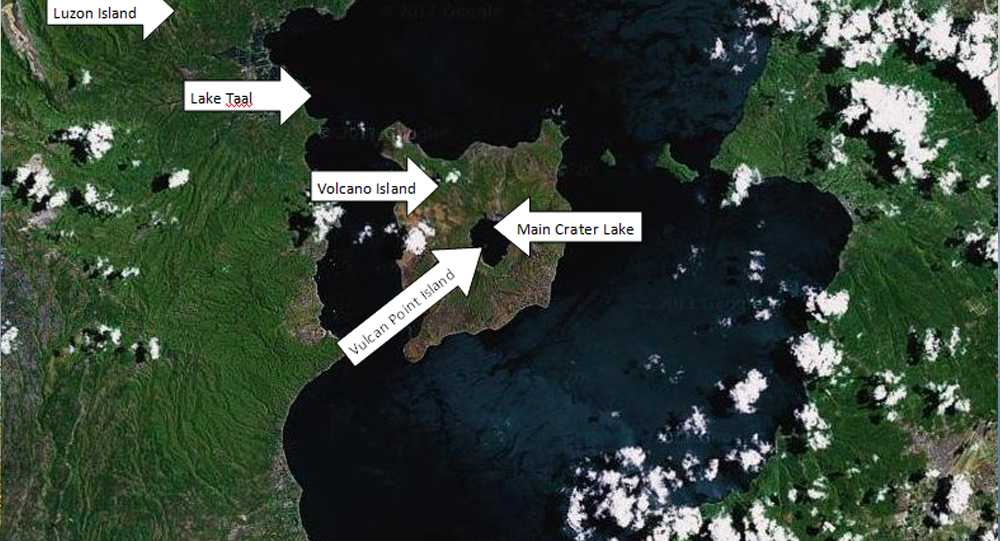
Taal volcano: The Island in a Lake on an Island in a Lake on an Island
Lake Taal, on the island of Luzon, in the Philippines archipelago's northernmost reaches, is unique. It's now one of just two lakes in the world with a third-order island within it, with the lake itself being a part of the order. In other words, Lake Taal, which is located on the island of Luzon, has a volcano (Volcano Island), a lake (Crater Lake), and its own little island (Vulcan Point).
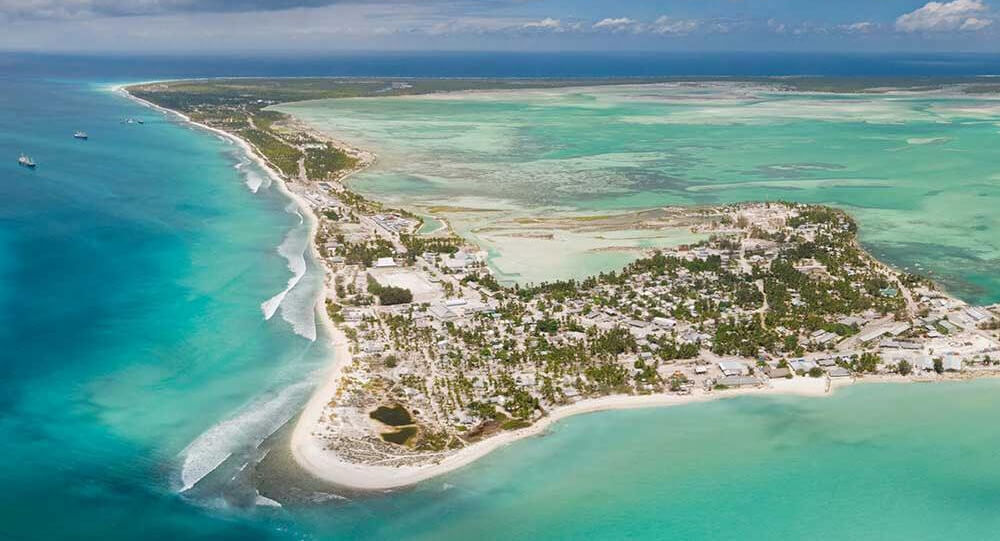
9 countries at risk of disappearing due to climate change
Although global warming is a serious threat to the entire planet, some geographical regions are more vulnerable to its effects.
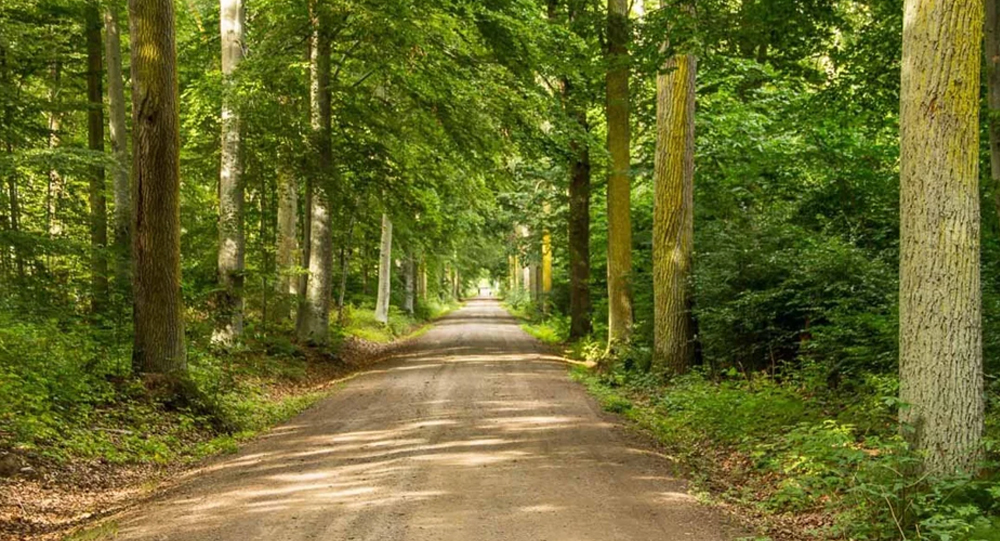
How Sweden’s 300,000 Oak Trees Became an Unintended Legacy: The Naval Forest That Outlived Wooden Warships
In the 1830s, Sweden planted 300,000 oak trees for the purpose of building naval ships. However, by the time the trees matured, metal warships had replaced the need for wooden ones. The forest still stands to this day.

Mystery SOLVED: blood Rain in India
The dissemination of spores of microalgae has been identified as the origin of the 'Blood Rain' phenomena, according to a new study by Indian and Austrian experts. Since 1896, reports of intermittent red-colored rain in portions of Kerala and Sri Lanka have been coming in. The most recent one occurred in 2013 over Kerala.