
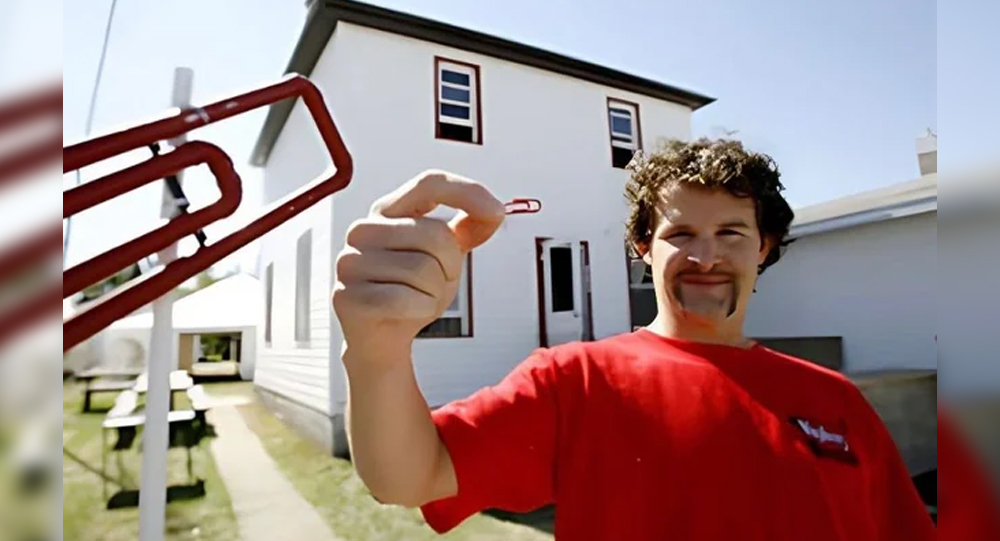
Kyle MacDonald’s adventure started on July 14, 2005, in Montreal, when he decided to test a childhood game called “Bigger, Better.” His goal? To trade a red paperclip for “something bigger, something better,” and see how far he could get. The first trade was simple—a red paperclip for a fish-shaped pen. Even at this modest start, Kyle’s story began to attract attention online as he chronicled each exchange on his blog.
The fish pen was quickly traded for a handcrafted doorknob by a Seattle potter, setting the tone for a journey fueled by creativity, storytelling, and connections.
The Trades That Captivated Thousands
Over the next year, Kyle’s trades grew increasingly impressive and creative. From the doorknob, he swapped for a Coleman camp stove in Massachusetts, followed by a Honda generator in California. Back east in New York, the generator turned into an instant party—a keg with free beer.
The party led to a snowmobile, which walked him to a trip to Yahk, British Columbia. Subsequent deals included a box truck, a recording contract, and even a day with the legendary rocker Alice Cooper. This afternoon meeting was traded for a KISS snow globe, caught the attention of the actor-director Corbin Bernsen, who then offered Kyle a role in an independent film.
From Movie Role to Farmhouse
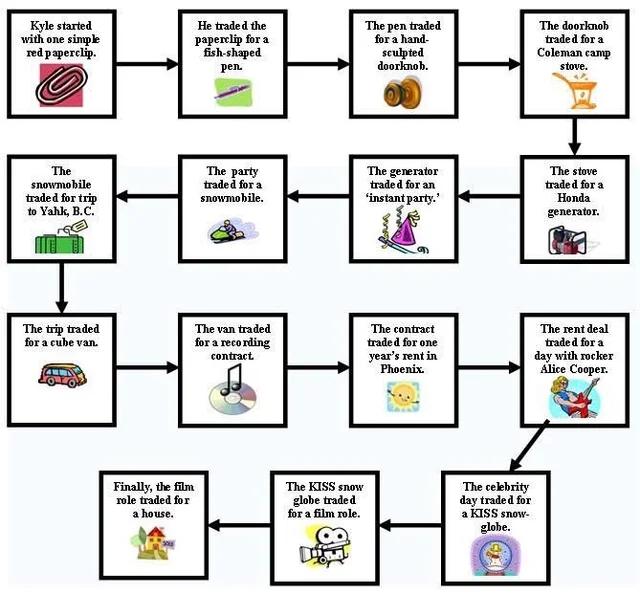
The climax of Kyle’s remarkable bartering story came when the small town of Kipling, Saskatchewan, agreed to trade a modest two-story farmhouse for the movie role Kyle had acquired. The deal was sealed exactly one year from his initial trade. Kipling welcomed Kyle with a ceremony and even erected the world’s largest red paperclip sculpture as a symbol of the story’s success and the town’s newfound fame.
The “Red Paperclip House” remains a symbol of innovation, community, and the potential of social barter.
More Than Just Trading: Lessons from the Journey
Kyle MacDonald’s red paperclip challenge was not just about material gain; it became a lesson in networking, storytelling, and perseverance. His blog created a global audience who watched and participated vicariously, helping spread the story across media outlets worldwide.
He often emphasized that each trade worked because it was meaningful to the other party—what he called “funtential,” or fun potential. This blend of value, humor, and connection made his journey unique and sustainable.
Fascinating Trivia About the Red Paperclip Journey
- Kyle’s blog chronicling the trades attracted dozens of thousands of daily visitors, launching the story into viral fame.
- His $1,000 reward offer was not part of the plan; the focus was on unique and interesting trades rather than money.
- The world’s largest red paperclip in Kipling stands roughly 15 feet (4.6 meters) tall and was unveiled on July 12, 2007.
- Some trades required Kyle to travel thousands of miles, turning the bartering into a cross-country adventure.
- The recording contract trade was with Metalworks, Canada’s largest music studio.
- The snowmobile was a pivotal item that elevated the scale of trades and media attention.
- Kyle published a book, One Red Paperclip: How an Ordinary Man Achieved His Dreams with the Help of a Simple Office Supply, detailing the experience.
- The story has inspired countless copycats worldwide attempting to trade upwards from small items.
Final Thoughts: Turning a Simple Idea into a Legendary Journey
Kyle MacDonald’s remarkable story of trading a single red paperclip into a house is a testament to human creativity, resourcefulness, and the power of community. It reminds us that sometimes, bold ideas paired with persistence and storytelling can turn the ordinary into the extraordinary.
So next time you look at a simple item, remember: with the right mindset, it could be the start of something incredible. Share this article to inspire others with the astonishing tale of the red paperclip that made history.
Sources & Further Reading:
- Town of Kipling: The Red Paperclip Story (2005)
- Guideposts: One Red Paperclip Day (2007)
- Wikipedia: One Red Paperclip
- Investopedia: 7 Billionaires’ First Jobs Including Kyle MacDonald
- CTV News: The Montreal Man Who Traded a Paperclip for a House (2025)
These sources provide comprehensive details about the trade sequence, media impact, and the community engagement surrounding this notable barter story.

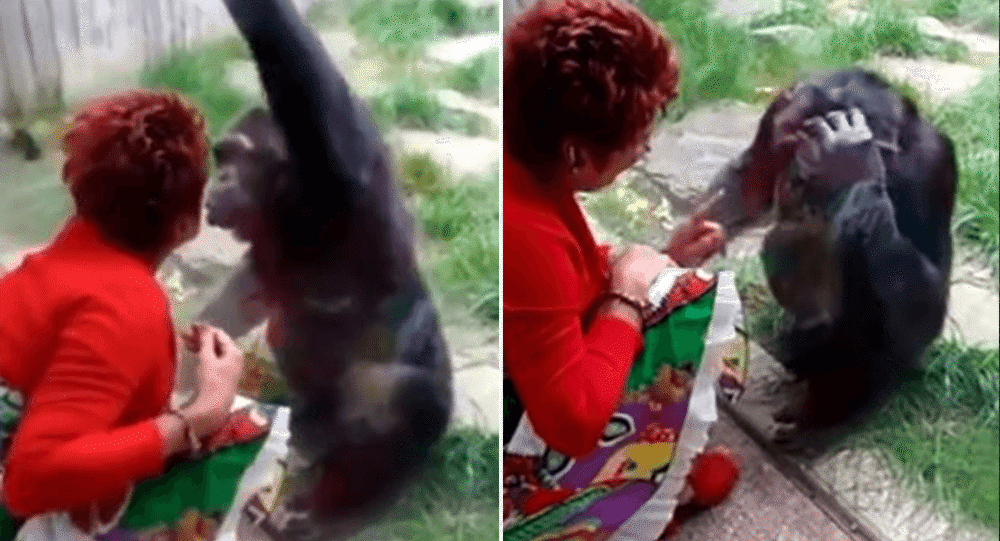
Belgian Woman Banned from Zoo After 4-Year Affair with Chimpanzee
A Belgian woman was banned from the zoo after having an affair with a chimp.
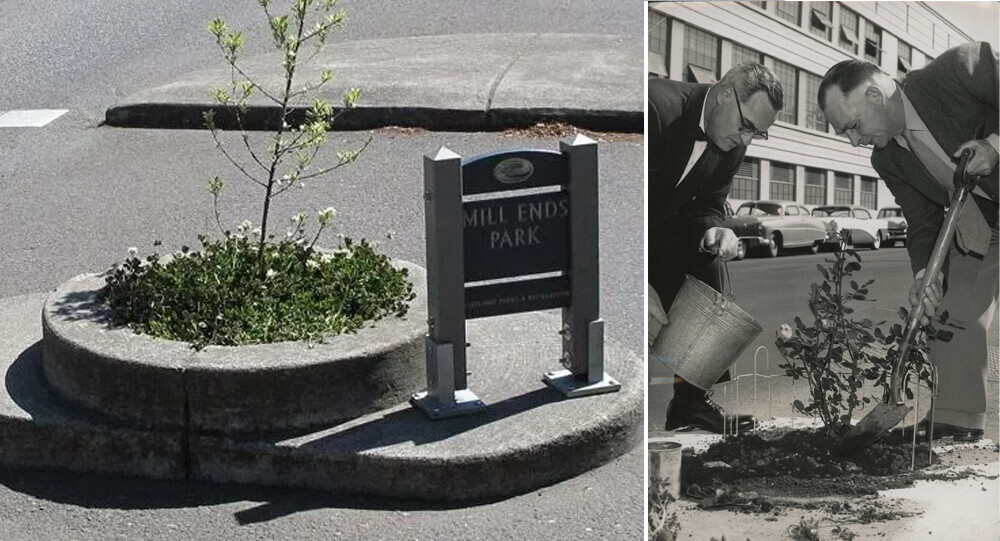
Mill Ends Park, the Smallest Park in the World
Portland, Oregon is home to the tiniest park in the world, a two-foot-diameter circle. Mill End Park is the name of this park.


Woman's memory reset every two hours after traumatic accident
Riley Horner, an Illinois teenager was accidentally kicked in the head. As a result of the injury, her memory resets every two hours, and she wakes up thinking every day is June 11. Riley keeps detailed notes of events happening throughout the day, and sets an alarm on her phone every two hours to remind her to review them. Riley also keeps a calendar in her room to remind her what day it is? As she wakes up every morning confused, thinking it's still June 11.

A man who has been suffering from headaches for nearly six months discovers chopsticks lodged in his brain
When it was discovered that a Vietnamese man with headaches and vision problems had chopsticks lodged in his brain, the doctors were almost as surprised as the man himself.

June and Jennifer Gibbons The silent twin who Only Spoke to Each Other
Identical twins June and Jennifer Gibbons were born on 11 April 1963 at a military hospital in Aden, Yemen where their father worked as part of the Royal Air Force.

Domestic Flight Delay Caused by Live Snake on Board Leaves Passengers in Shock
A domestic flight was unexpectedly delayed for nearly two hours after a snake was discovered slithering inside the plane’s cargo hold. Thanks to the swift efforts of a professional snake catcher and airline staff, the reptile was safely removed without any harm to passengers, turning a potentially alarming situation into a story of caution and calm.

This Thai Wedding Tradition Happens 40 Feet Underwater
Each year in Trang, Thailand, dozens of couples participate in an underwater wedding ceremony while scuba diving in full gear. The ritual symbolizes deep love and has become a quirky tourist attraction held around Valentine’s Day.
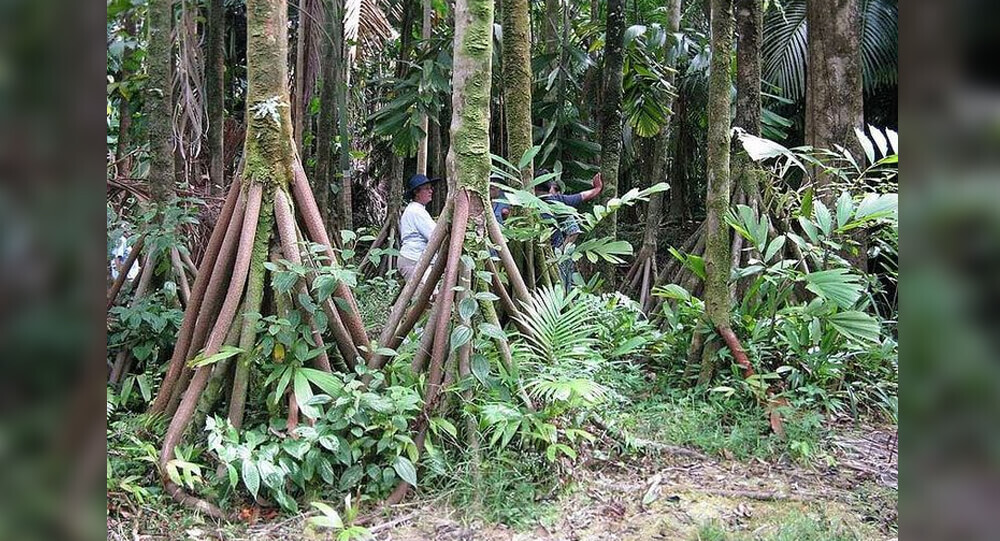
The “Walking” Palm, tree species can walk up to 65 feet each
This tree species can walk up to 65 feet each year to find the best habitat to live in.
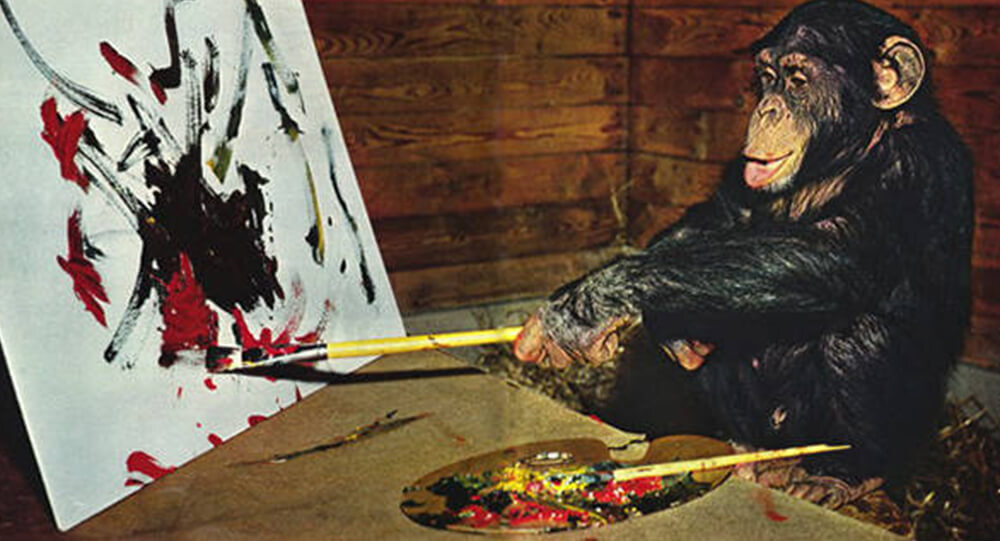
Pierre Brassau: The chimpanzee painter who deceived the avant-garde world
Abstract paintings by a previously unknown artist “Pierre Brassau” were exhibited at a gallery in Sweden, earning praise for his “powerful brushstrokes” and the “delicacy of a ballet dancer”. None knew that Pierre Brassau was actually a 4 year old chimp from the local zoo.
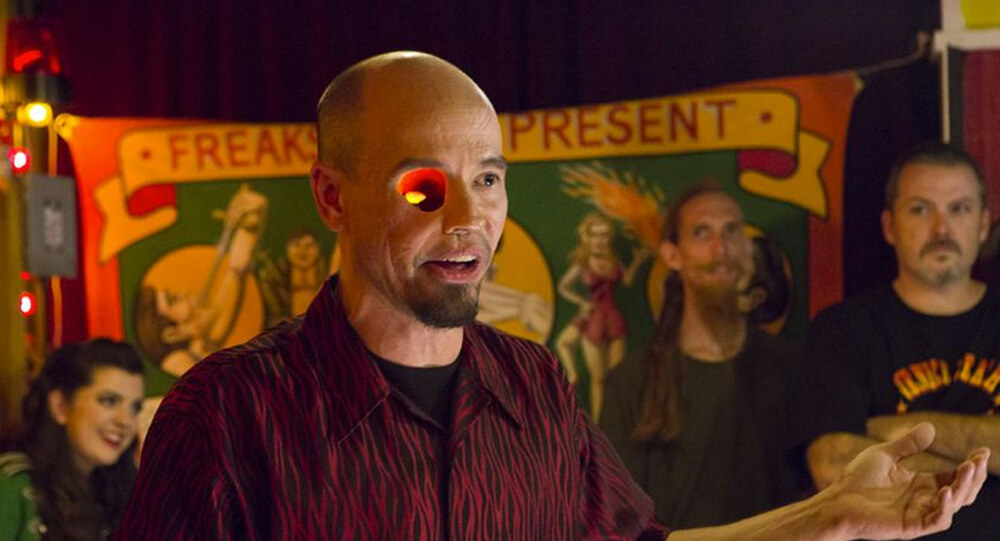
Inspirational Journey of Billy Owen From Cancer Patient to Zombie Actor
A man called Billy Owen lost an eye and half of his face to cancer and used it to start a career as a zombie actor.

Sandy Island: The Phantom Island That Fooled Maps and Google Earth for Centuries
Sandy Island, charted since 1774, was long considered a phantom island in the Coral Sea. Despite appearing on maps and Google Earth, it was "undiscovered" by scientists in 2012, revealing only deep ocean instead of land. The island's existence was likely a cartographic error or a misidentified pumice raft.
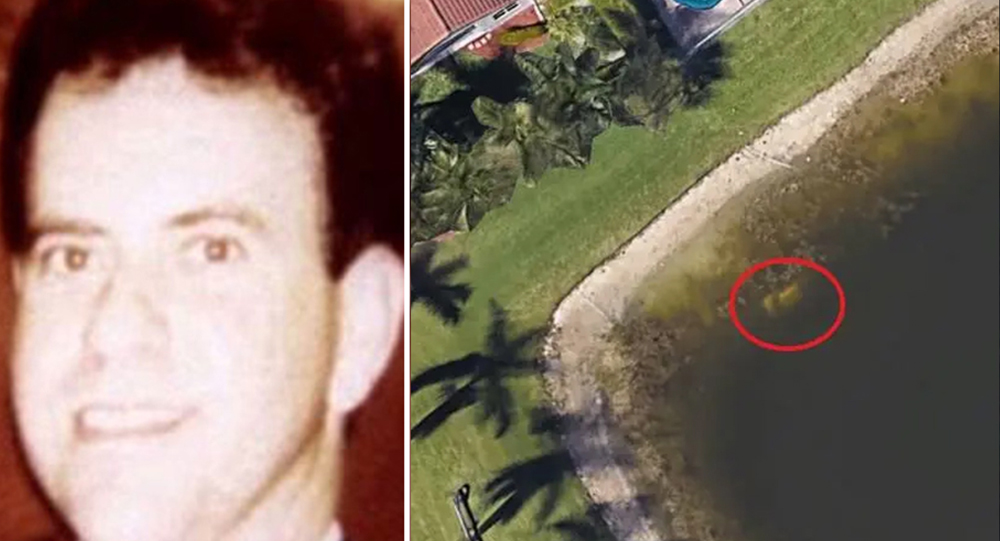
The Google Maps Discovery: the Mystery of William Moldt's Disappearance
In 2019, Google Maps helped solve the decades-old mystery of William Moldt, who disappeared in 1997. A former resident spotted his submerged car in a retention pond while using Google Earth. The vehicle, visible since 2007, contained Moldt's skeletal remains, providing closure to his case.

Nevada’s Fly Geyser Is A Surreal Wonder That Looks Like Its On Another Planet
In 1964, an energy company accidentally created Nevada’s Fly Geyser after drilling into a geothermal pocket. Since then, the geyser has been releasing algae-filled scalding water five feet in the air, depositing minerals and forming a cone that sports vibrant hues of green and red.

Chocolate Rain in Switzerland: How a Factory Malfunction Turned Olten Into a Sweet Spectacle
In 2020, chocolate 'rained' from the sky in a town in Switzerland. This incident was caused by a ventilation system malfunction at a chocolate factory in Olten. Strong winds then carried the snow-like cocoa powder and spread it around in the immediate vicinity of the factory, covering cars and other things in chocolate.
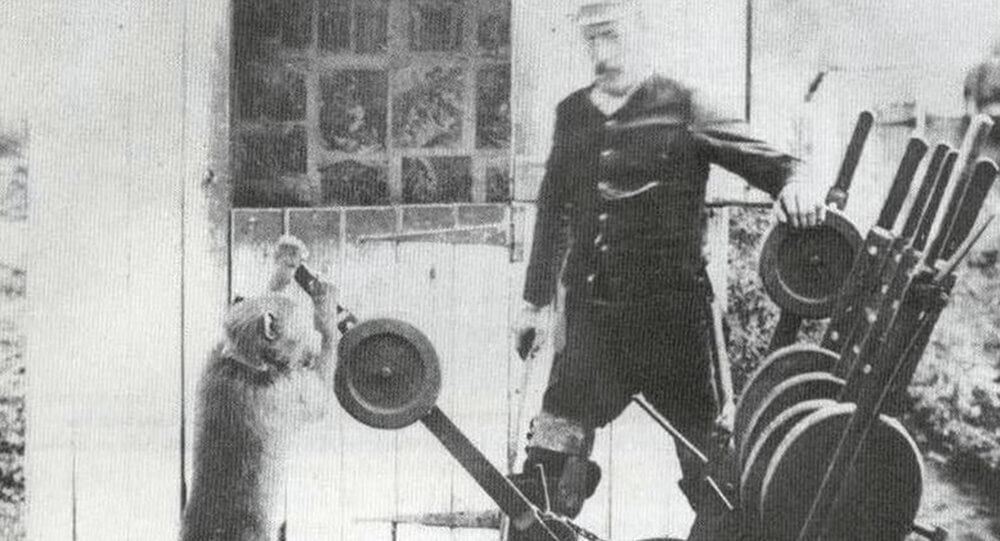
Jack the Baboon operated a railroad, earned a living, and never made a mistake
A baboon worked as a signalman for the railroad in the late 1800s. He never made a mistake and worked for the railroad until the day he died.

The Miracle Baby: Nigerian Couple in the UK Welcomes a Rare Blonde, Blue-Eyed Child
A black, Nigerian couple living in the U.K. gave birth to a white, blonde, blue-eyed baby that they call the "miracle baby."
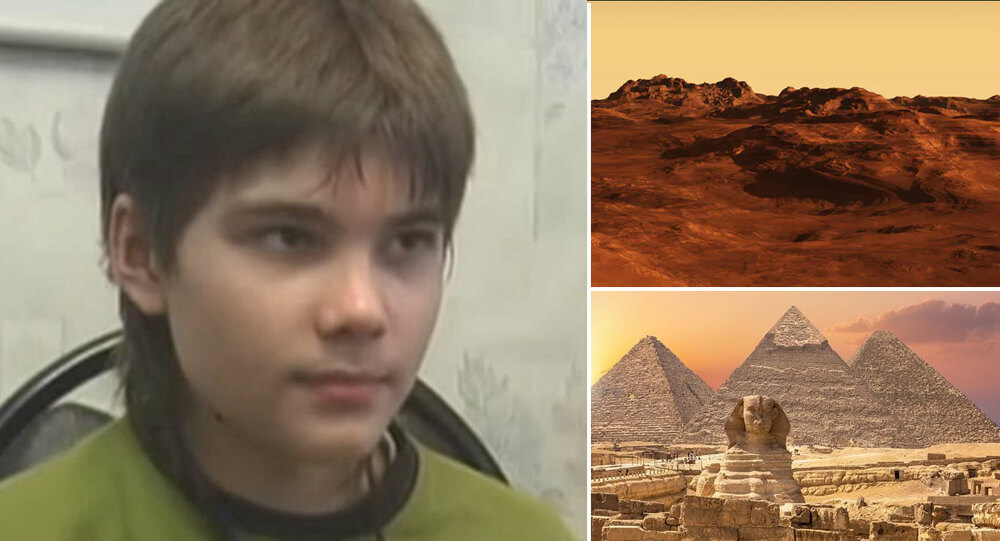
The story of a boy who claims to be on Mars: Boriska Kipriyanovich
Boriska Kipriyanovich, who lives in Volgograd, Russia, claims he lived on Mars before being resurrected on Earth on a mission to redeem humanity. What we know about him is as follows:
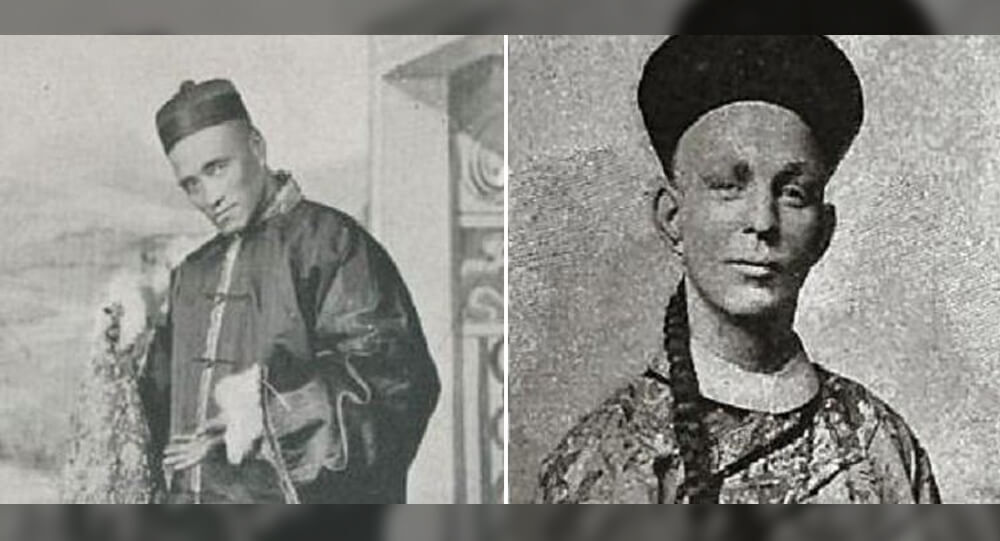
The Bizarre (And Magical) Duel Between Chung Ling Soo And Ching Ling Foo
Ching Ling Foo and Chung Ling Soo were two magicians from the early 20th century who were bitter rivals. While Ching Ling Foo was genuinely Chinese, Chung Ling Soo was actually a New Yorker named William Robinson.
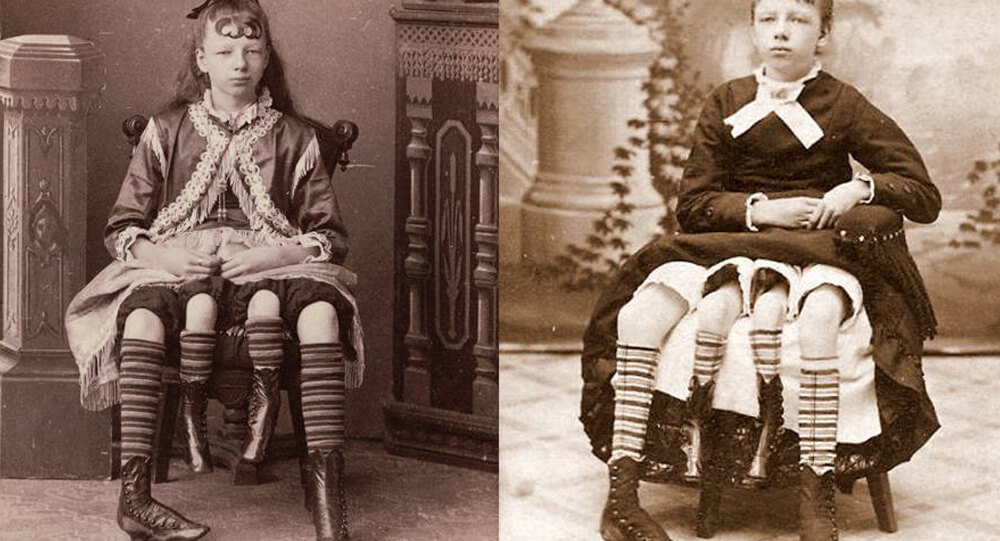
The true story of Josephine Myrtle Corbin, the lady born with four legs and two private parts
Josephine Myrtle Corbin, an American sideshow performer born in 1868, had a rare condition known as dipygus, which caused her to have four legs, each smaller inner leg paired with one of her outer legs. Corbin joined the sideshow circuit, captivating audiences as the "Four-Legged Girl from Texas."

Upside-Down Fig Tree From The Roof Of An Ancient Ruin in Italy
There is an upside-down fig tree in Bacoli, Italy. No one is quite sure how the fig tree ended up there or how it survived, but year after year, it continues to grow downwards and bear figs.
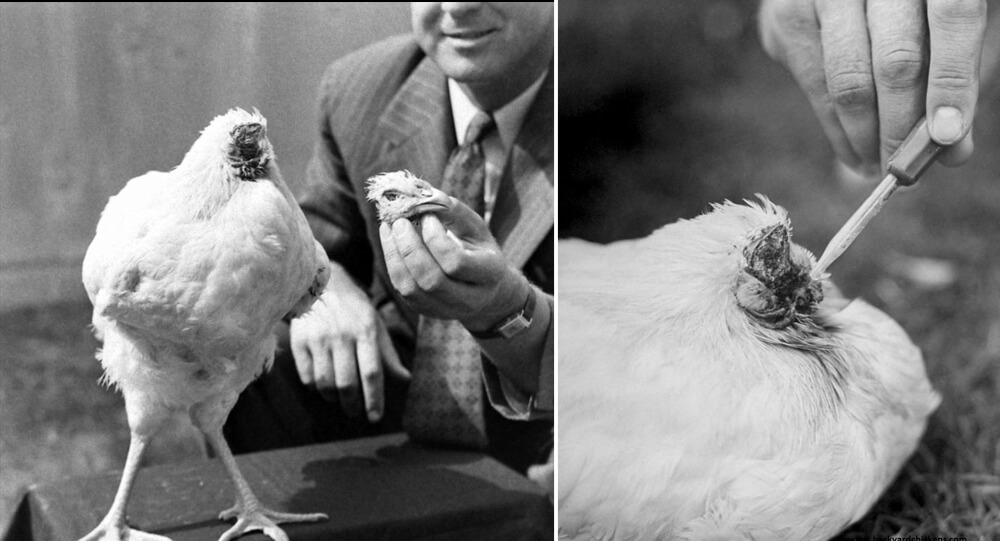
The story of The chicken that lived for 18 months without a head
Mike the Headless Chicken was a rooster whose head was accidentally chopped off but miraculously survived. This is due to most of the brain stem being left intact. He was fed using a special tube that delivered food directly into his esophagus. Despite his lack of a head, he lived for 18 months, gaining worldwide fame before ultimately choking on a kernel of corn during one of his tours, in a Motel in Fruita, Colorado.
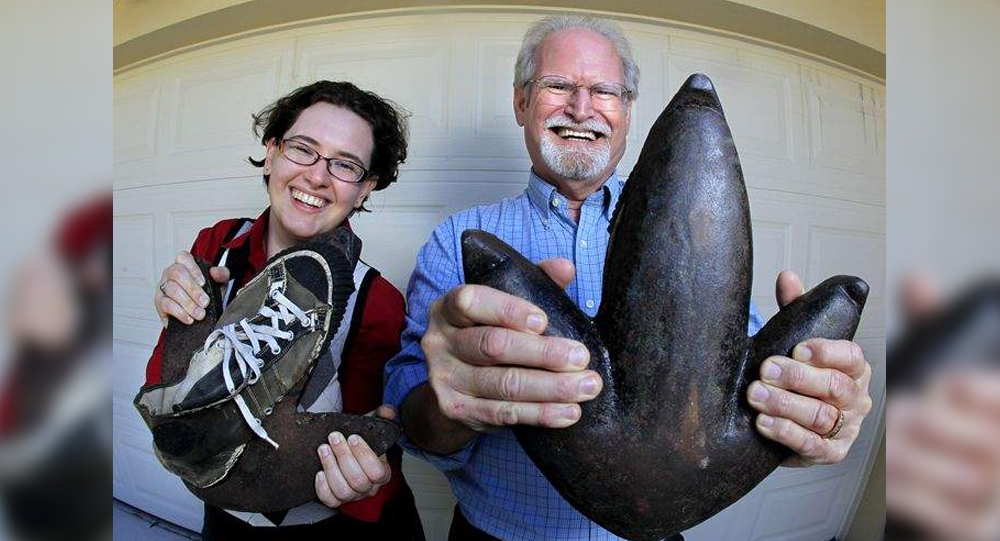
How a Man Fooled Florida with Fake Penguin Tracks for 10 Years
In 1948, Florida’s Clearwater Beach was the stage for one of the longest-running and most peculiar hoaxes in American folklore. Giant three-toed footprints appeared mysteriously in the sand, sparking rumor and fascination about a 15-foot-tall penguin roaming the shores. For a decade, locals and visitors alike speculated and scanned for the elusive creature, never realizing the truth: these tracks were made by a man wearing 30-pound lead shoes designed to imitate an enormous penguin's footprint. This article uncovers the details of this elaborate prank and its lasting legacy in Florida’s cryptic history.
![[solved] “macaroni mystery”, 500 pounds of pasta dumped in new jersey](https://weeklyrecess.com/wp-content/uploads/2024/05/Macaroni-Mystery-cover.jpg)
[solved] “macaroni mystery”, 500 pounds of pasta dumped in new jersey
In April 2023, Old Bridge, New Jersey, faced a peculiar 'Macaroni Mystery' when 500 pounds of pasta were mysteriously dumped in the woods.
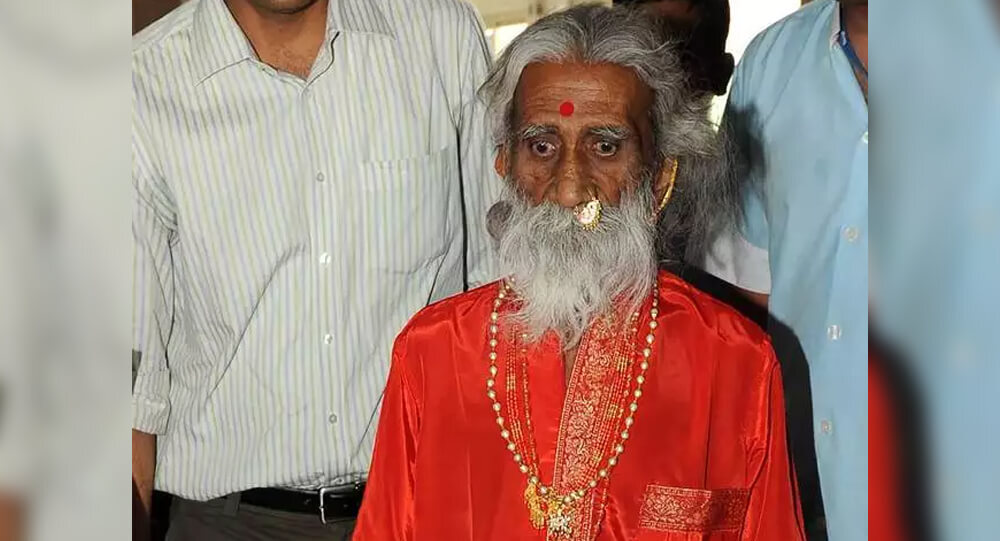
This Yogi Spent 76 Years Without Eating or Drinking Anything and Confirmed by
Prahlad Jani, the starving monk who lived 76 Years without food and water.
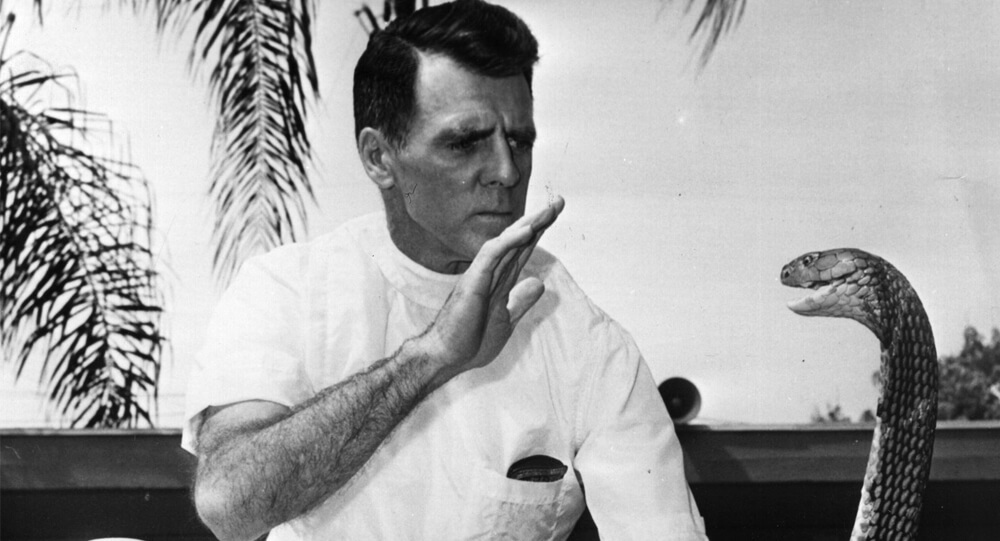
The story of Bill Haast, who lived to be 100 despite his extensive snake venom injections
Bill Haast immunized himself by injecting snake venom into his blood for several years. He holds the Guinness World Record for surviving the most lethal snake bites, having been bitten over 172 times. Bill became known as "Snake Man" around the world and lived for over 100 years.