


In 1502, the renowned explorer Christopher Columbus, who is credited with discovering the New World, set out on his fourth and final voyage in the hopes of discovering a western route to Asia. This expedition, however, proved to be his most difficult and ultimately brought about an unexpected turn of events. Columbus and his crew encountered difficult conditions and uncertainty while stranded in Jamaica during their journey. In an amazing turn of events, a lunar eclipse was crucial to their survival. This article explores the fascinating tale of how Christopher Columbus ended up stranded in Jamaica and how he cunningly used the impending lunar eclipse to bargain his way out of this precarious circumstance.
Christopher Columbus’s Stranded Voyage to Jamaica
Ah, the story of Christopher Columbus, the traveler who accidentally discovered America and forever altered the course of human history. What about his less well-known exploits, such as the time he got lost in Jamaica? Yes, it appears that even renowned explorers occasionally find themselves in a sticky situation. Come with me as we examine the events leading up to Columbus’s fateful encounter with a lunar eclipse on his fourth and final voyage.
The Journey: Columbus’s Fourth and Final Voyage
Columbus set out on his fourth and final voyage in 1502, full of hope and a little bit of wanderlust. His goals were to find a western route to the Far East, amass wealth, and perhaps discover a few uncharted territories along the way. Columbus set out in search of glory with three ships: the unassuming-sounding but sturdy Santa Mara de la Victoria, the forgotten-sibling-of-the-Nia, La Capitana, and the tried-and-true Santiago. He had no idea what adventures awaited him.
Stranded in Jamaica: Events leading to the Eclipse
Imagine Columbus’ fleet arriving in Jamaica in 1503; they are exhausted and in need of rest. But alas, luck was not on the side of our brave explorer. The crew needed time to make repairs because the ships were damaged. Days became weeks, and then weeks became months. The crew soon understood they were stranded, and their worry quickly turned to desperation.
Being the resourceful man that he was, Columbus decided to engage in negotiation. By promising that their god would reward their generosity, he persuaded the locals to provide the necessities for his crew. Days again turned into weeks, and food became scarce. As they anxiously awaited word that they would be rescued from this beached purgatory, the crew and the locals’ patience grew thin.
The Superstitious Natives: Response to the Stranded Europeans
Columbus and his crew encountered a mixture of superstition and curiosity as they interacted with Jamaica’s native population. The natives initially viewed them with suspicion because they were unfamiliar with the presence of Europeans. While some perceived them as divine visitors, others thought they were cursed creatures who were to blame for their misfortune.
Ever the diplomat, Columbus used his charm and wit to win over the locals. Through his efforts, he won their confidence and eventually persuaded them to exchange their priceless supplies for insignificant trinkets. The locals were superstitious, but they were also shrewd negotiators, despite their superstition.
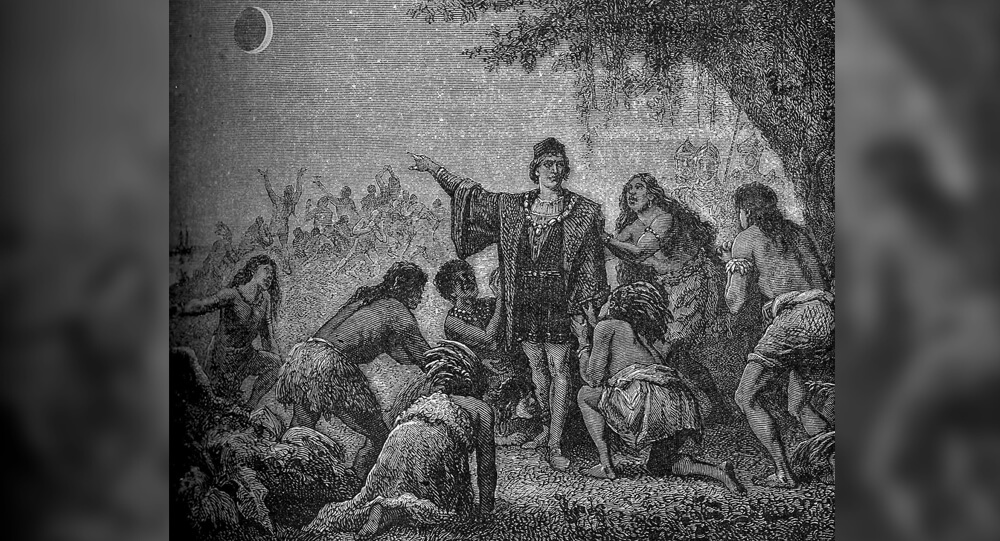
Columbus and his crew had no idea that a celestial event would drastically alter their situation. A lunar eclipse illuminated the Jamaican sky on the evening of February 29, 1504, giving the night a sinister glow. The superstitious natives rushed to give Columbus and his crew an abundance of provisions, thinking it was a sign from their gods, in an effort to win their favor.
Columbus and his crew said goodbye to their temporary haven in Jamaica and set sail once more into the unknown, their bellies full and spirits high. The stranded voyage had come to an end, leaving behind a tale of diplomatic skill, resourcefulness, and a dash of lunar good fortune.
But keep in mind that even the most accomplished explorers occasionally become stranded and reliant on the generosity of strangers and the whims of nature. Therefore, the next time you find yourself in a difficult circumstance, just remember Christopher Columbus and his lunar eclipse journey. Who knows, maybe everything will come together for you as well.
Columbus’s Ingenious Plan: Predicting the Lunar Eclipse
When Christopher Columbus and his crew got stuck in Jamaica in 1504, they had a difficult task ahead of them: persuading the locals to keep bringing them food and supplies. Columbus, ever the resourceful traveler, devised a brilliant scheme to astound and impress the locals: he predicted a lunar eclipse.
Columbus had access to almanacs that detailed celestial events and was well-versed in astronomy. He was aware that on February 29, 1504, there would be a lunar eclipse. With this information in hand, he approached the Cacique (chief) in the area and asked to meet with his council.
The Agreement with the Natives: Columbus’s Negotiation Tactics
Columbus took advantage of the upcoming lunar eclipse in his meeting with the tribal council. In retaliation for their lack of cooperation, he informed the council that he had the authority to cause the moon to vanish. He forewarned them that the moon would vanish from the sky on the appointed night if they did not furnish him and his crew with provisions.
Naturally, the locals were dubious at first, but as the predicted date approached, they grew more concerned. Columbus made a show of praying before announcing that he would spare the moon from disappearing as a sign of mercy after sensing their fear and desperation. However, he made it clear that this act of goodwill would only continue if the natives continued to provide the necessary supplies.
The Miracle of the Eclipse: Impact and Resolution
The locals gave the crew an abundance of food and supplies as the night of the lunar eclipse drew near, curious to see if Columbus could truly control the celestial forces. Knowing he had to keep his word, Columbus checked his almanac and correctly predicted when the eclipse would occur.
Columbus acted as though he were in deep prayer that fateful night as the moon started to eclipse, and he dramatically begged the heavens for help. The moon then started to reappear as if by magic. The natives were in awe and fear as they watched this extraordinary event. They instantly knelt at Columbus’ feet, pleading for his pardon and promising to give the crew whatever they required.
The miraculous lunar eclipse not only saved Columbus and his crew from starvation but also secured their safety and well-being during their time in Jamaica.

The mysterious secret of Dr James Barry
Before women were allowed to enroll in medical school, Margaret Ann Bulkley studied medicine and assumed the identity of Dr. James Barry for 56 years while dressing as a man. After 46 years of service as an army doctor officer, her secret was not made public until after her death in 1865.

Atomic Tourism: In the 1950s, nuclear tests in Las Vegas served as a draw for tourists
Between 1950 and 1960, Las Vegas offered “Atomic Tourism” in which guests could watch atomic bombs being tested in the desert as a form of entertainment.

D.B. Cooper: Man who hijacked a plane and jumped out with a $200,000
On November 22, 1971, DB Cooper hijacked a Boeing 727, drank a whisky, smoked a fag, and then jumped out of the plane with $200,000. He was never again seen.

15 interesting facts about Queen Elizabeth II
Queen Elizabeth II, who ruled Britain for 70 years, has away at the age of 96. She was the country's longest-reigning monarch. Here are some little-known facts about her.

During the 1996 Olympic bombing, Richard Jewell falsely accused of committing the crime after saving dozens of people
Richard Jewell, an American security guard, discovered a bomb during the 1996 Olympic Games in Atlanta and assisted in the evacuation, but was later wrongfully accused and faced public scrutiny. He was cleared, but it had a lasting impact on him until his death in 2007 at the age of 44.

Albert Einstein’s brain after it was stolen from his body
Albert Einstein's brain was taken by the opportunistic pathologist who performed his autopsy hours after he died and kept in two jars for 30 years. The stolen brain of Albert Einstein was preserved in a cookie jar for 30 years until being discovered by a journalist.

The Amazing Truth About The German U-Boat That Was Sunk By A Toilet
During WWII, a German captain and an engineer flushed the submarine's high-tech toilet incorrectly, causing the vessel to rapidly fill with water. British planes patrolling the sea attacked them as the submarine was brought to the surface. While many members of the crew were killed in the attack, the captain escaped!

Irena Sendler: woman who rescued Jews during holocaust
Irene Sendler was the Zegota resistance group's head of the children's department. She risked her life to smuggle children out of the Warsaw ghetto, place them with Polish families or orphanages, give each child a new identity, and keep records so that they could be returned to their families. In 1943, the Gestapo arrested and sentenced her to death, but she was rescued by Zegota.

Story of Kathrine Switzer: the first woman to run in Boston Marathon
Before women were allowed to run in the Boston Marathon, Kathrine Switzer participated. A race official attempted to forcefully remove her from the race in 1967, but her boyfriend pushed him down. She was the first female finisher who had a numbered entry in the race.

What exactly was the US's 'Ghost Army' during WWII?
During WW2, there was a special unit of men dubbed the ‘Ghost Army’. The unit was made of artists, creative and engineers and their job was to create deception about the enemy. From inflatable tanks to phony convoys to scripted conversations in bars intended to spread disinformation, they used all possible tricks to fool the enemy.

Susanna Salter: The Trailblazing Story of America’s First Female Mayor
In 1887, Susanna Salter became the first female mayor in the United States, elected in Argonia, Kansas. Her nomination was initially a prank by men opposing women in politics. However, she won by a landslide and served effectively, inspiring the women’s suffrage movement and breaking barriers for women in leadership.

Why the Word ‘Pen’ Comes from the Latin ‘Penna’ Meaning Feather
The humble word “pen” carries a rich history rooted in ancient times, derived from the Latin word penna, meaning “feather.” Long before modern pens revolutionized writing, feather quills—especially from geese—were the essential tools of scribes, scholars, and artists. This article journeys through the origins of the pen, its evolution, and fascinating trivia about the timeless connection between feathers and writing.

The Littlest Skyscraper: How J.D. McMahon’s 480-Inch Con Fooled Investors in 1919
In 1919, J.D. McMahon convinced investors to fund a 480-foot skyscraper, but he labeled the plans as 480 inches, building a 40-foot structure instead. After taking $200,000, he won in court since the plans matched what he built.

Ancient Jericho: The First Walled City In History
The ancient city of Jericho is the world's oldest walled city, with evidence of stone fortifications dating back nearly 9000 years.

Terry Fox, a 21-year-old one-legged cancer patient who ran 143 days before dying
Terry Fox was a 21-year-old one-legged cancer patient who ran 3,339 miles across Canada in 143 days before dying.

Titanoboa cerrejonensis, fossils of the world’s largest species of snake
In 2009 in a coal mine of Columbia, scientists discovered fossils of the world’s largest species of snake. The species is called “Titanoboa cerrejonensis,“and it is from around 60 million years ago. It would have had measured about 48 feet long and weighed about 2,500 pounds

June and Jennifer Gibbons The silent twin who Only Spoke to Each Other
Identical twins June and Jennifer Gibbons were born on 11 April 1963 at a military hospital in Aden, Yemen where their father worked as part of the Royal Air Force.

The Bizarre (And Magical) Duel Between Chung Ling Soo And Ching Ling Foo
Ching Ling Foo and Chung Ling Soo were two magicians from the early 20th century who were bitter rivals. While Ching Ling Foo was genuinely Chinese, Chung Ling Soo was actually a New Yorker named William Robinson.

Inside The Mysterious Death Of The Famed Gothic Writer Edgar Allan Poe
Hours before his death Edgar Allen Poe was found on the streets of Baltimore. He was incoherent, wearing another man’s clothes, and unable to explain how he got there. The cause of his death is an unsolved mystery.

New London School Explosion, Deadliest school disaster which killed almost 300 children and teachers
In 1937, a gas leak in the basement at the local school in New London, Texas caused a massive explosion which killed almost 300 children and teachers, the deadliest school disaster in US history. Adolf Hitler even sent his condolences by telegram.

What Was the Beast of Gévaudan?
Between 1764 and 1767, a mysterious animal called the Beast of Gévaudan terrorized the French village called Gévaudan. It attacked and killed about 100 adults and children. While most believe it was a wolf, some say it may have been a wolf-dog hybrid, hyena or even a lion, but without any genetic evidence, the beast will remain a mystery forever.

Archaeologists Uncover 2,000-Year-Old Amazonian Cities Using Lidar Technology
Deep in the Ecuadorian Amazon, archaeologists have uncovered an ancient network of urban settlements once inhabited by the Upano people about 2,000 years ago. Using cutting-edge lidar technology, these discoveries reveal a highly organized society featuring sophisticated agricultural systems, drainage canals, and extensive road networks. This transformative find challenges long-held assumptions about ancient Amazonian societies and sheds light on a complex civilization thriving in one of the world’s most biodiverse regions.

The Baltic Way: the longest unbroken human chain in history
On August 23, 1989, about 2 million people from Latvia, Estonia, and Lithuania formed a human chain that united all 3 countries to show the world their desire to escape the Soviet Union and the communism that brought only suffering and poverty. This power stretched 600 km.

Nicholas Winton ‘British Schindler’: Man who rescued 669 Czech children from Nazis
A man named Nicholas Winton saved 669 kids during WWII and lived almost all his life without letting people know.

Nearest Green, America's first known Black master distiller
Nathan "Nearest" Green was an African-American head stiller who is now more frequently referred to as a master distiller. He was renowned for imparting his distilling knowledge to Jack Daniel, the creator of Jack Daniel's Tennessee whiskey distiller, after Jack Daniel was freed from slavery following the American Civil War.