

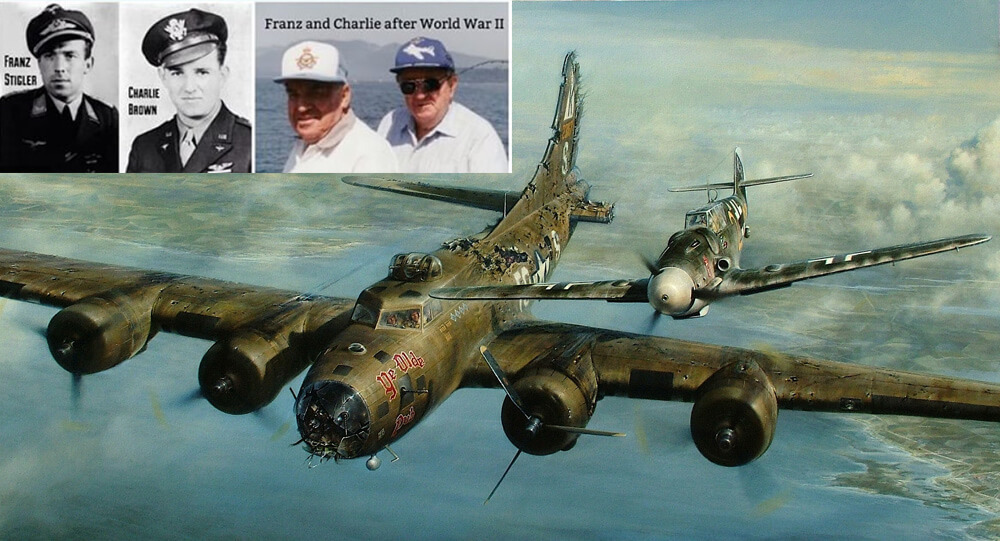
The Charlie Brown and Franz Stigler incident happened on December 20, 1943, when German fighters severely damaged Charles “Charlie” Brown’s B-17 Flying Fortress (named “Ye Olde Pub”) following a successful bomb run on Bremen. Despite having the chance to bring down the damaged bomber, Luftwaffe pilot and ace Franz Stigler chose to let the crew return to their airfield in England for humanitarian reasons. The two pilots eventually crossed paths 40 years later after a thorough search by Charlie Brown, and the friendship they formed lasted until their deaths.
Pilots
Farm boy from West Virginia and 2nd Lt. Charlie Brown flew the B-17F for the 379th Bomber Group of the United States Army Air Forces (USAAF) at RAF Kimbolton in England. Franz Stigler, a veteran Luftwaffe fighter pilot from Bavaria who had previously flown for an airline, was a member of Jagdgeschwader 27 at the time and had amassed 22 victories. With one more enemy aircraft brought down, he would qualify for the coveted Knight’s Cross.
Bomb run
Brown’s B-17 started its 10-minute bomb run at 27,300 feet, in minus 60 °C of outside air. Accurate anti-aircraft fire damaged the bomber’s Plexiglas nose, disabled the number two engine, and further damaged the number four engine, which had to be throttled back to avoid overspeeding before the bomber released its bomb load. Due to the bomber’s slowing down from the damage, Brown was unable to stay with his formation and retreated as a straggler, where he would be subject to continuous enemy attacks.
Attacks by fighters
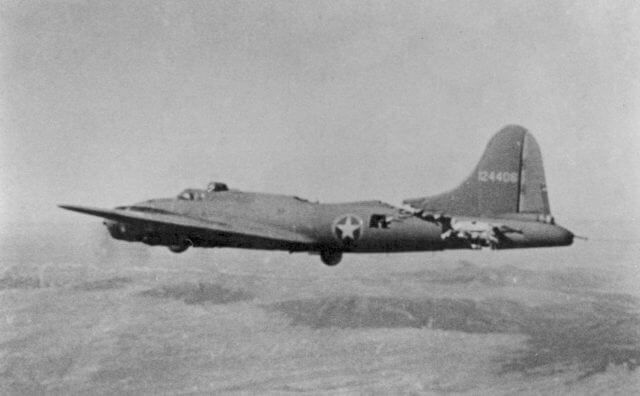
 Brown’s B-17 was even more damaged than this one; the B-17 pictured was able to land with all their crew alive.
Now, for more than ten minutes, more than a dozen enemy fighters—a mix of Bf-109s and FW-190s—attacked Brown’s lone B-17. Additionally, the number three engine, which could only produce half power, suffered damage (meaning the aircraft had at worst 40 percent of its total rated power available). Internal oxygen, hydraulic, and electrical systems of the bomber were also compromised. The bomber’s two dorsal turret guns and one of its three forward-firing nose guns were its sole remaining defensive armament (from eleven available). The majority of the crew were now injured (the tail gunner had died), and Brown had a shoulder injury.
When Brown ran out of oxygen, he passed out. When he awoke, the bomber was remarkably flying level at a height of about 1000 feet. He regained the controls and started the long journey home in the wrecked bomber.
Franz Stigler
Germans on the ground, including Franz Stigler, who was refueling and arming at an airfield, noticed Brown’s damaged bomber. He quickly accelerated in his Messerschmitt Bf-109 and caught up to Brown’s aircraft. Stigler was able to see the hurt and helpless crew clearly through the bomber’s damaged air frame. The crippled bomber was not attacked by Stigler, which surprised the American pilot.
During his time fighting in North Africa, Gustav Rödel recalled the advice of one of his commanding officers from the Jagdgeschwader 27: “You are fighter pilots first, last, always. If I ever hear of any of you shooting at someone in a parachute, I’ll shoot you myself.” Stigler later commented, “To me, it was just like they were in a parachute. I saw them and I couldn’t shoot them down.”
Stigler made two attempts to convince Brown to either land his aircraft at a German airfield and surrender or to make a U-turn and land in nearby neutral Sweden, where he and his crew would receive medical care but would also be interned and forced to sit out the rest of the war. Brown objected and carried on. Then Stigler flew close to Brown’s aircraft, escorting it until they reached the North Sea, and then he took off while saluting.
Landing
Brown was able to fly his aircraft the 250 miles across the North Sea and land it at RAF Seething, home of the 448th Bomb Group. He then told his officers about how a German pilot had let him go during the post-flight debriefing. In order to avoid creating a favorable impression of enemy pilots, he was instructed not to mention this to the other members of the unit. While Stigler was aware that a German pilot who spared the enemy while in battle risked execution, Brown remarked that “someone decided you can’t be human and be flying in a German cockpit.” Stigler kept the incident a secret from his commanding officers.
Lt. Brown went on to complete a combat tour.
Post-war and meeting of pilots
Charlie Brown returned to West Virginia after the war, attended college there, and then enlisted in the Air Force once more in 1949, serving there until 1965. Later, he traveled to Laos and Vietnam a lot while serving as a Foreign Service Officer for the State Department. But he decided to become an inventor in Miami in 1972, so he gave up his job as a government employee.
In 1953, Stigler moved to Canada and established a prosperous business.
Colonel Charlie Brown, who had just retired, was asked to give a speech in 1986 at the “Gathering of the Eagles,” a gathering of combat pilots. After being questioned about his most memorable missions from World War II, Brown took a moment to reflect and remembered the tale of Stigler’s escort and salute. Brown then made the decision to look for the unidentified German pilot.
Brown had spent four years looking in vain for American and West German Air Force records that might provide some insight into the identity of the other pilot, but he had not found much. Then he sent a letter to the newsletter of a group of combat pilots. Brown got a letter from Stigler, who was residing in Canada, a few months later. It declared, “I was the one. Stigler gave Brown all the information he needed to know to identify him as the German fighter pilot when they spoke on the phone about his plane, including the escort and salute.
Franz Stigler and Charlie Brown became close friends between 1990 and 2008, and they remained so until their deaths a few months apart in 2008.

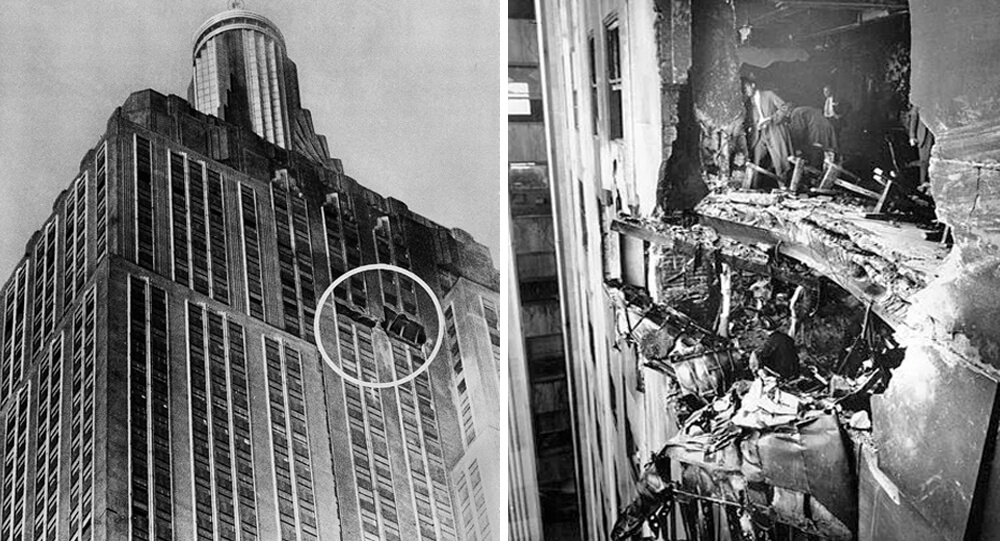
Remembering the 1945 Empire State Building Disaster: When a Plane Met Skyscraper
An airplane crashed into the Empire State Building in 1945. Among other damage, plane parts severed the cables of an elevator and the woman inside fell over 70 stories. She lived and holds the world record for the longest survived elevator fall.

10 world’s most destructive and dangerous volcanic eruptions in history
Volcanic eruptions can devastate cities, change the world's atmosphere, and devastate economic systems. They can create molten lava rivers, mudslides, suffocating ash, and poisonous gases that cause chaos around the world for years. A volcanic explosion's effects can be massive, from its size to its death toll to its economic cost. Here is ten world’s most destructive and dangerous volcanic eruptions in history.

Juliane Koepcke: The Teenager Who Fell 10,000 Feet And Trekked The Jungle to survive
In 1971, a high school student was sucked out of an airplane after it was struck by lightning. She fell 10,000 feet to the ground while still strapped to her chair and survived. Only to endure a 9-day trek to the nearest civilization.

The World’s First Seismograph: How Ancient China Detected Earthquakes 1,800 Years Ago
Over 1,800 years ago, long before modern technology, the ancient Chinese astronomer and inventor Zhang Heng created the world’s first seismograph in 132 AD. This ingenious bronze device could detect distant earthquakes by releasing small balls from dragons’ mouths into toads’ mouths—each indicating a different compass direction. Its historic detection of an earthquake 400 miles away astonished the imperial court and transformed the way societies understood and responded to seismic events.
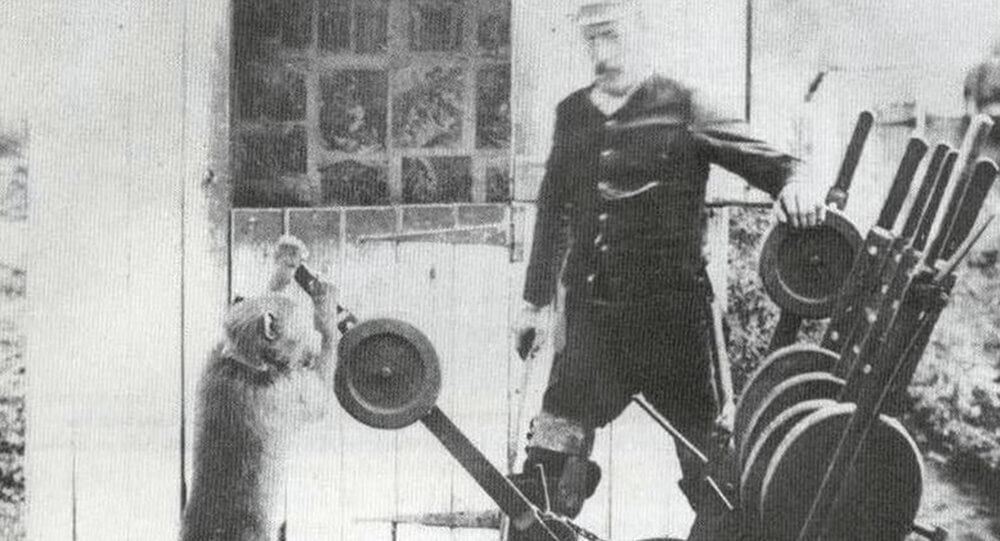
Jack the Baboon operated a railroad, earned a living, and never made a mistake
A baboon worked as a signalman for the railroad in the late 1800s. He never made a mistake and worked for the railroad until the day he died.

Man's Blood Helped Save Millions of Babies
Australian blood donor James Harrison has been one of our most impressive and valued donors, having donated for 60 years. Know his story, how he was a pioneer of our Anti-D program, and why this matters.
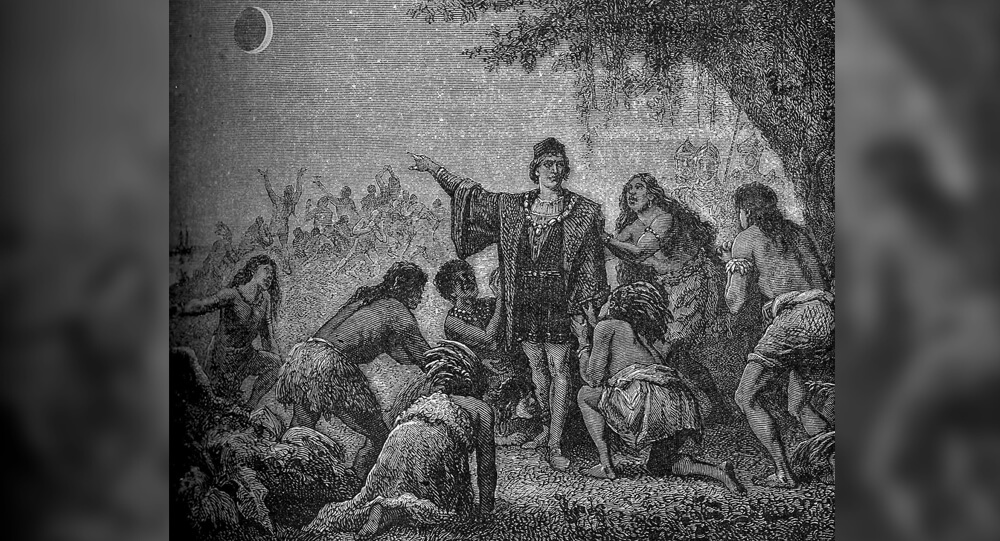
How a Total Lunar Eclipse Saved Christopher Columbus in 1504
In 1504, Christopher Columbus was stranded in Jamaica with natives who refused to give him food. But he knew the date and time of an upcoming lunar eclipse. So he told the natives that his gods were angry at their treatment of him, and would provide a clear sign. Once the eclipse started, the natives raced to give him food and begged for mercy.
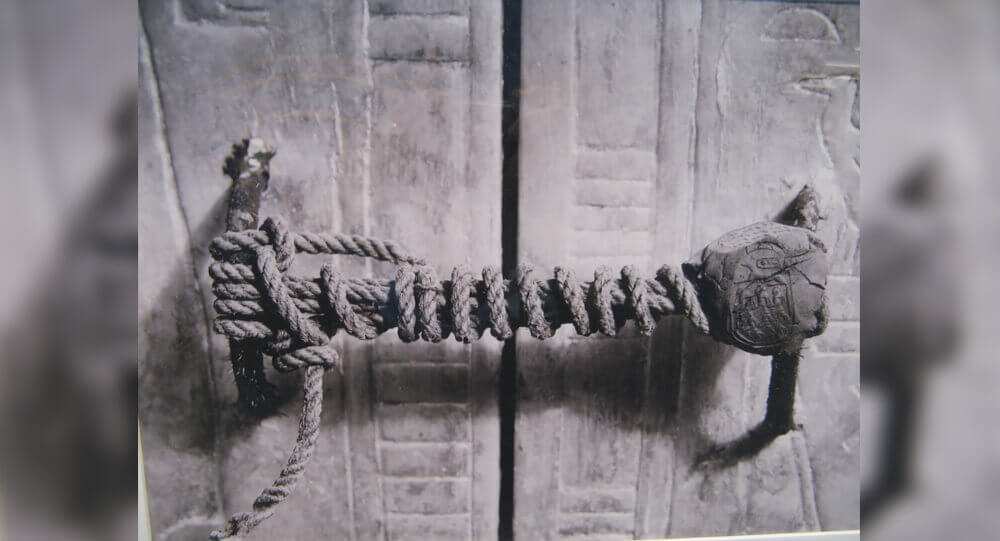
The unbroken seal on King Tutankhamun's tomb until 1922
The unbroken seal of Tutankhamun's tomb before it was opened in 1923, it was unbroken for over 3000 years.
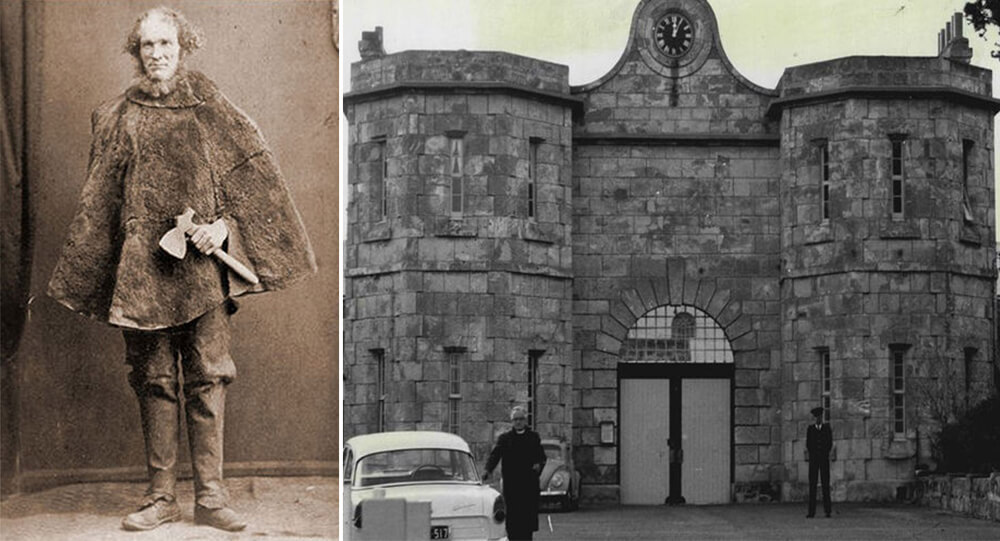
Moondyne Joe: The story of Australia's most notorious prison escapee
A man named Joseph Bolitho Johns (A.K.A Moondyne Joe) broke out of Australian prisons so many times that the police were compelled to build a special cell just for him. He escaped from that as well.
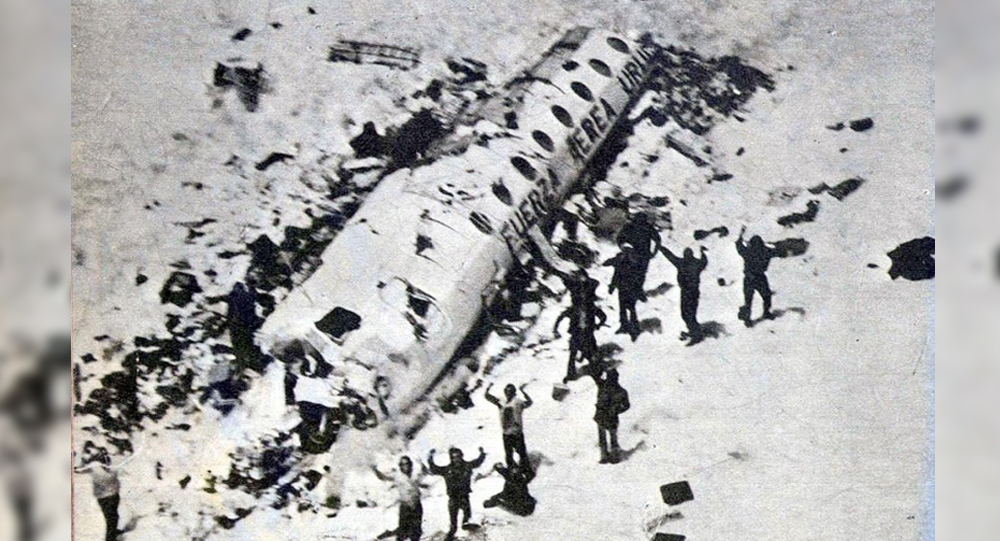
1972 Andes Plane Crash Survivor recall the terrifying Struggles to Stay Alive
On October 13, 1972, a plane carrying a rugby team from Uruguay crashed in the Andes between Chile and Argentina. The survivors were in brutal conditions - high altitude, bitter cold, and the lack of food—and faced the most terrible choice—eating the frozen flesh of their dead friends or starving to death themselves.
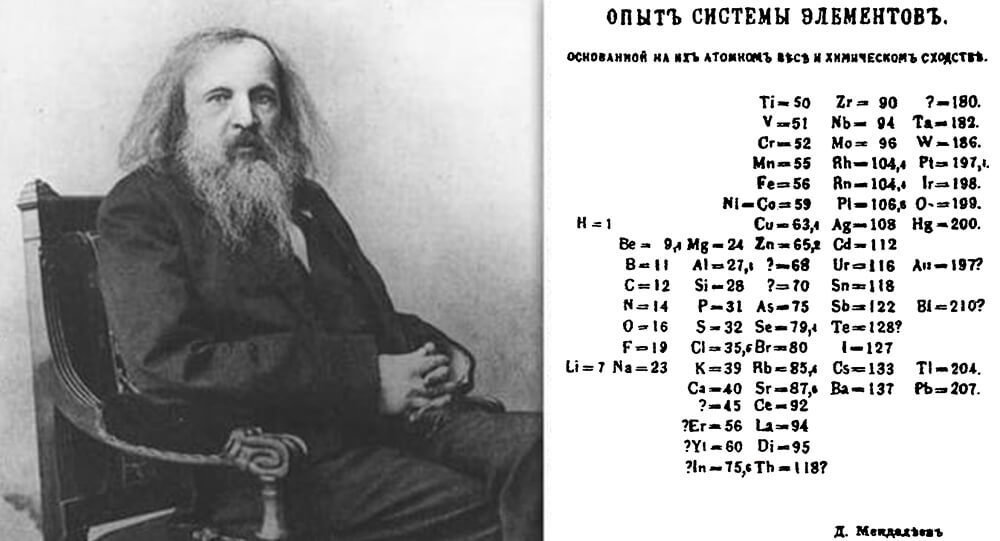
How Dmitri Mendeleev Developed the periodic table of the elements
1850 Dmitri Mendeleev walked almost a thousand miles to Moscow so he could apply for the University of Moscow. Although he was not accepted, he walked to St. Petersburg where he was accepted, And with that education, he developed the the periodic table of the elements

George Dantzig solved two famous “unsolved” problems in statistics mistakenly as assignment
In 1939, George Dantzig arrived late to his statistics class. On the board were two famous “unsolved” problems in statistics written as an example by his professor. Dantzig mistook the examples for homework assignments. He solved the “unsolved” problems and submitted the homework to his professor a few days later. His solutions earned him a doctorate.

The youngest person executed, George Stinney Jr was proven innocent
In 1944, George Stinney Jr. was 14 years old when he was executed in South Carolina. It took only ten minutes to convict him — and 70 years to exonerate him.

The history of Flour sack clothing fashion
After Kansas mill owners found women reused flour sack materials into apparel in the 1920s and 1930s, they started applying patterned designs to give families with more fashionable patterns and material.
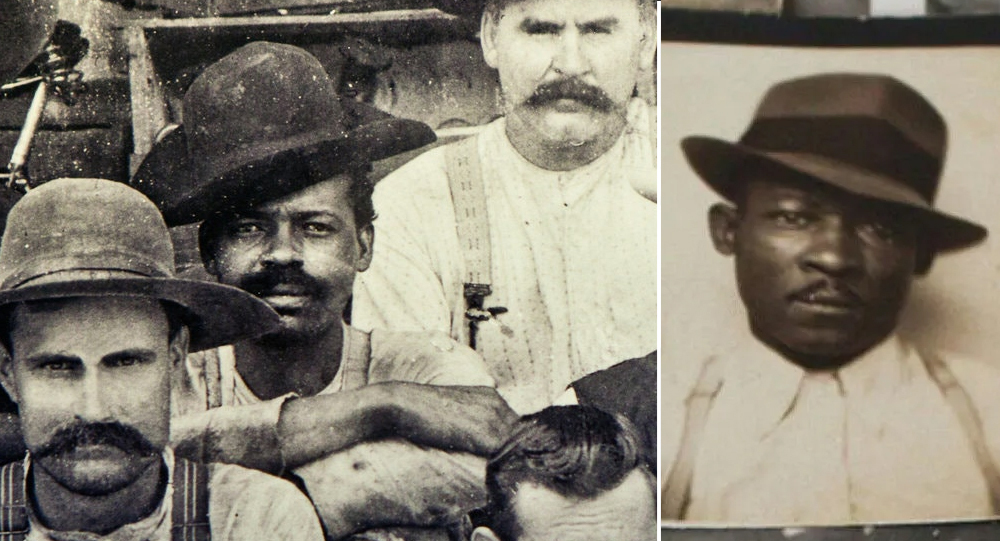
Nearest Green, America's first known Black master distiller
Nathan "Nearest" Green was an African-American head stiller who is now more frequently referred to as a master distiller. He was renowned for imparting his distilling knowledge to Jack Daniel, the creator of Jack Daniel's Tennessee whiskey distiller, after Jack Daniel was freed from slavery following the American Civil War.

Knockers-up: waking up the Industrial Britain's Workers in 1900-1941
Before alarm clocks were invented, there was a profession called a knocker-up, which involved going from client to client and tapping on their windows (or banging on their doors) with long sticks until they were awake. It lasted into the 1920s.

Top 10 most cruel medical procedures that are being used today
We are all aware that medicine has advanced dramatically over the last fifty years. There are several modern medical approaches available today, but this was not always the case. However, the past of medicine is a dark one. Medical leeches, lobotomy, vascular surgery, cranial stenosis, and even electroshock therapy are all options. These are only a couple of the cruel healing techniques that are still in use today.
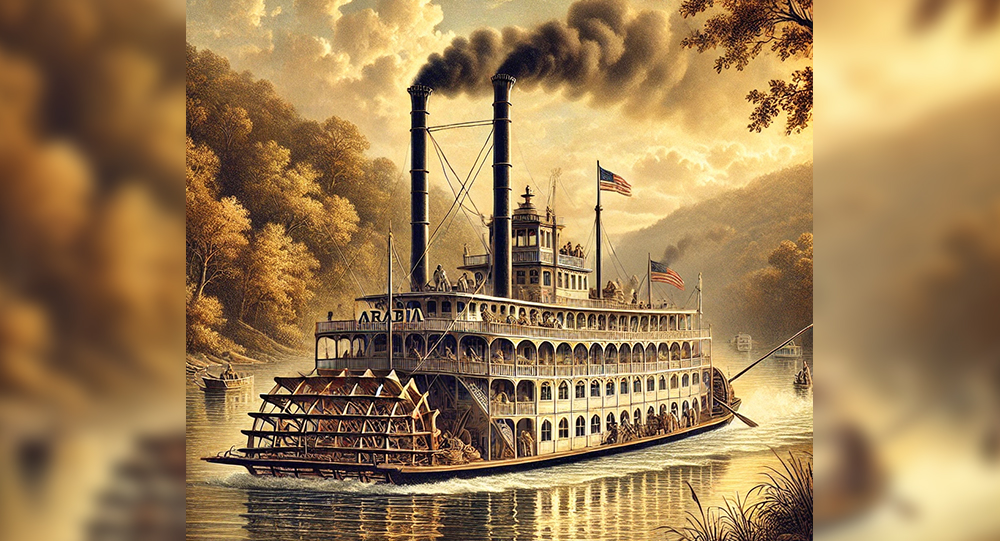
The Arabia Steamboat: Unearthing a 19th Century Time Capsule from the Missouri River
The Arabia was a steamboat that sank in the Missouri River in 1856. Over time, the river shifted 800 meters to the east, eventually turning the site of the sinking into a field. The steamboat remained under 45 feet of slit and topsoil until 1988, when it was excavated. The mud, as it turned out, was such a great preserver that most of the artifacts on board were found to be intact. They even found jars of preserved apples that were still edible!
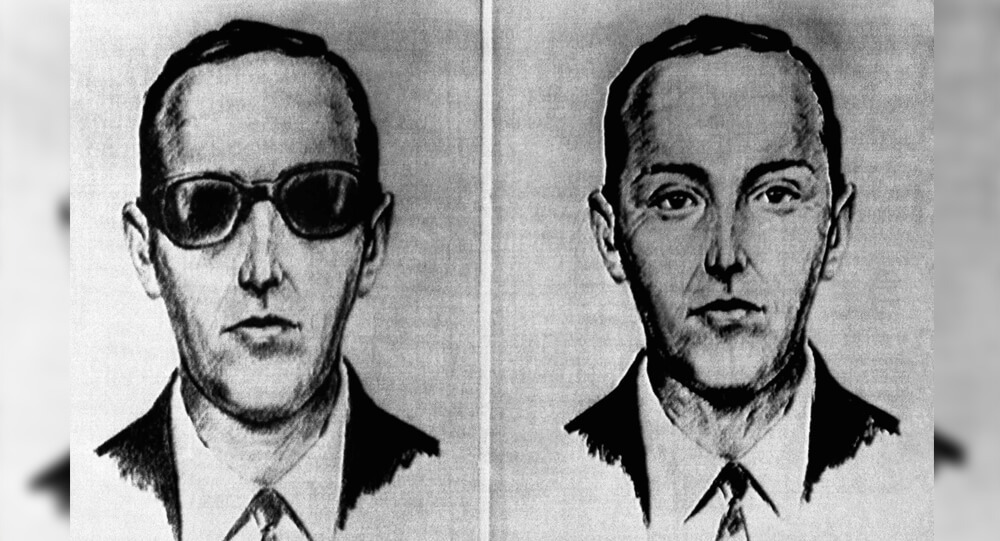
D.B. Cooper: Man who hijacked a plane and jumped out with a $200,000
On November 22, 1971, DB Cooper hijacked a Boeing 727, drank a whisky, smoked a fag, and then jumped out of the plane with $200,000. He was never again seen.

Nathan's Famous Doctor Stunt
When Nathan's Famous Hot Dogs first opened in 1916, the owner hired people to dress as doctors and eat hot dogs outside his shop, to convince people his hot dogs were healthy.

Marion Stokes recorded 30 years of television
Marion Stokes, a Philadelphia woman began taping whatever was on television in 1979 and didn’t stop until her death in 2012. The 71,000 VHS and Betamax tapes she made are the most complete collection preserving this era of TV. They are being digitized by the Internet Archive.
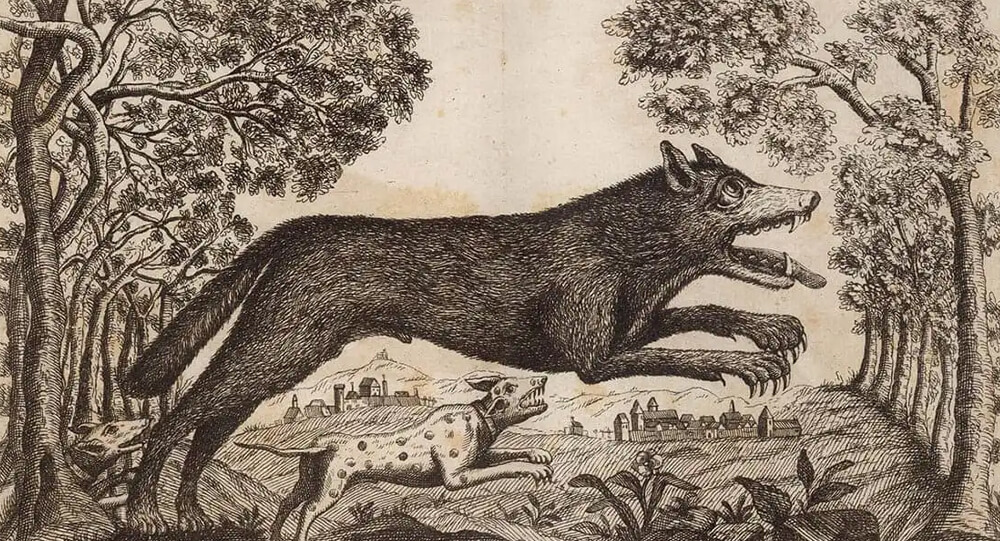
What Was the Beast of Gévaudan?
Between 1764 and 1767, a mysterious animal called the Beast of Gévaudan terrorized the French village called Gévaudan. It attacked and killed about 100 adults and children. While most believe it was a wolf, some say it may have been a wolf-dog hybrid, hyena or even a lion, but without any genetic evidence, the beast will remain a mystery forever.
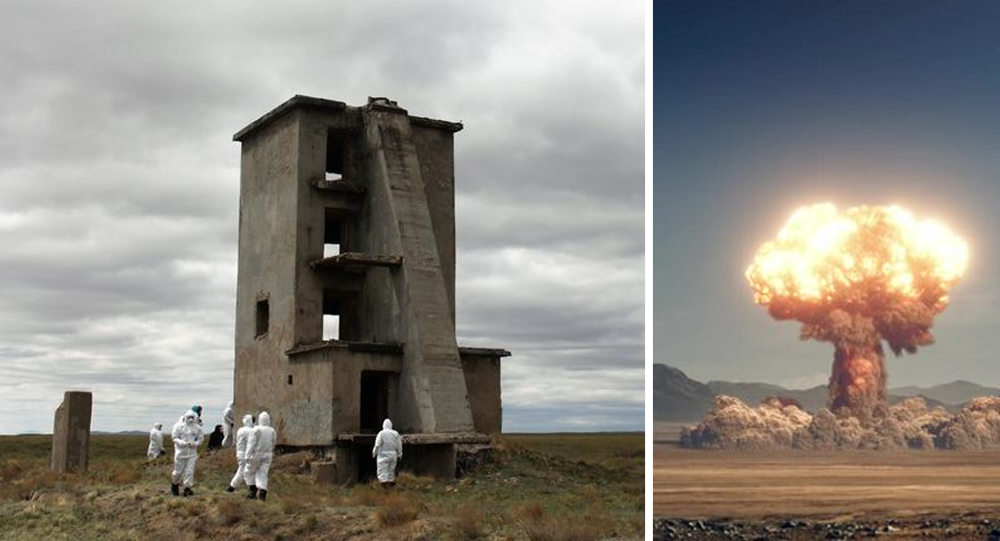
The Forgotten Story of Semipalatinsk and the Soviet Nuclear Experiments
Between 1949 and 1989, the Semipalatinsk Test Site in Kazakhstan became the primary location for Soviet nuclear weapons tests, exposing millions of unsuspecting villagers to radioactive fallout. Known as the “Polygon of Suffering,” this remote desert witnessed 456 nuclear detonations that caused widespread health crises, birth defects, and generational genetic damage. This article narrates the chilling legacy of Semipalatinsk, unveiling the human cost of Cold War arms development and the ongoing struggle for healing and recognition in Kazakhstan.
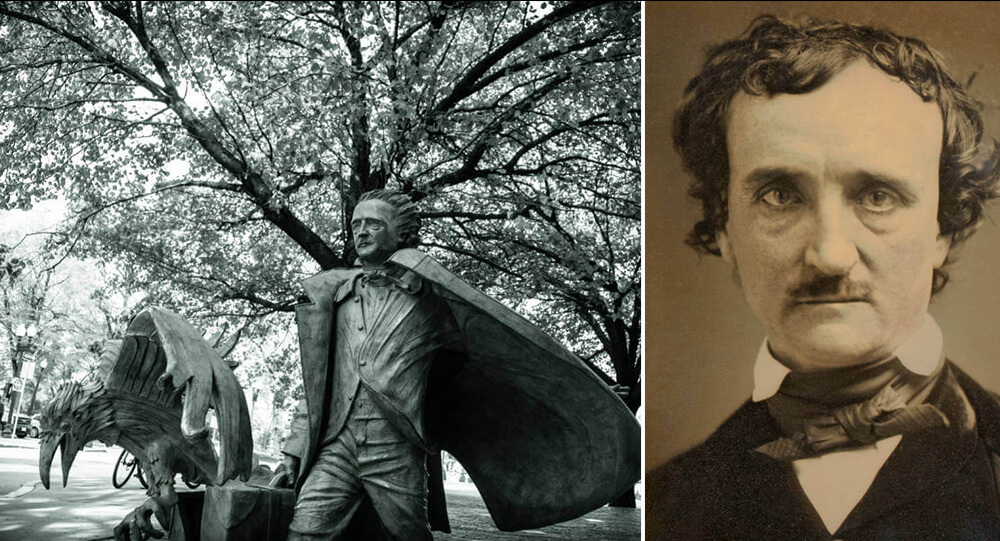
Inside The Mysterious Death Of The Famed Gothic Writer Edgar Allan Poe
Hours before his death Edgar Allen Poe was found on the streets of Baltimore. He was incoherent, wearing another man’s clothes, and unable to explain how he got there. The cause of his death is an unsolved mystery.
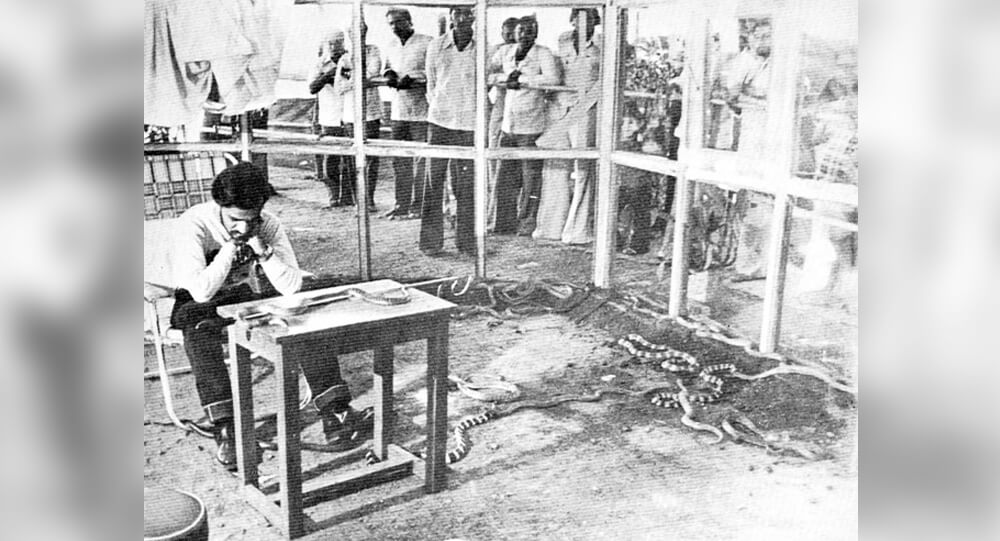
The story of a man who spent 72 hours with 72 venomous snakes to prove they only bite when provoked
In the 1980s, an Indian man spent 72 hours in a glass cabin with 72 snakes, some of which were extremely venomous. His aim was to prove that snakes only attack when provoked. Remarkably, he was not bitten once in those 72 hours and even set a Guinness World Record in the process.