

Current Date: 19 Nov, 2025
{{entry.title}}

3 men lived on top of a billboard in tents for almost 9 months

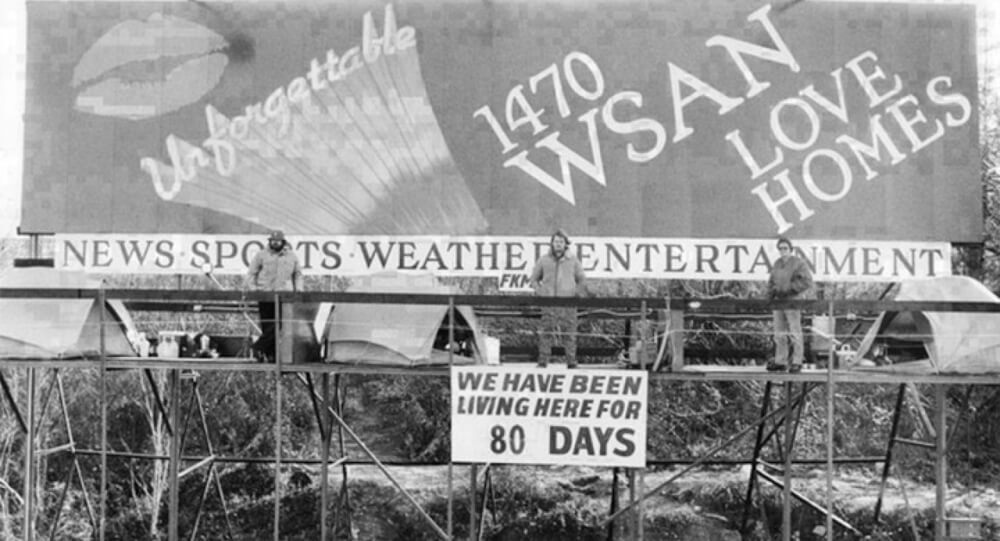
From 1982-1983, three men in Allentown PA competed in a radio contest in which they lived on top of a billboard in tents. Whoever stayed up longest would win a house. Due to economic pressure from the recession, none of the contestants wanted to give up, so the contest lasted almost 9 months.

Forty years ago, a radio competition began in the Lehigh Valley and resulted in a worldwide media frenzy.

In an attempt to gain publicity, the staff of Allentown radio station WSAN-AM, which was undergoing a rebranding, decided to hold a contest on September 20, 1982.

It was dubbed a “endurance contest,” with three participants competing to see who could spend the longest on the platform of a WSAN billboard located in Whitehall Township, across from the Lehigh Valley Mall, off of Route 22.

A new mobile home would be awarded to the winner.

However, the competitors turned out to be more serious than anticipated, and it took 261 days, a drug bust, and entreaties from government officials to bring the competition to an end.

Ned Teter, a WSAN radio DJ who worked the entire competition, said, “We were all taken a little off guard.”


“You do realize that this occurred long before social media, cell phones, or anything else like that? In 1982, nothing becomes viral. However, this was picked up by a few major publications, and after that, there were waves upon waves of coverage.

A housing crisis

The contestants were:

Mike MacKay was a newlywed in his first year of marriage and had a job. In a 2017 documentary titled “Billboard Boys,” it is stated that MacKay submitted 47,000 contest entries to WSAN, stating that he was unable to afford housing even with a steady job. In 2006, MacKay passed away.

It is purported that Dalton Young entered roughly a thousand contests shortly after his release from the United States. military. While residing on the billboard, he was ultimately taken into custody by an undercover police officer for marijuana-related offenses.

There are rumors that Ron Kistler submitted 4,004 entries to the WSAN office. He claimed in the documentary that he was only competing for a house, not for attention.

For more than a year, the competitors occupied the billboard platform equipped with space heaters, tents, toilets, phones, radios, and even a pulley system that allowed loved ones to bring them food and other necessities.

Housing shortages in the Lehigh Valley in the early 1980s contributed to the competitors’ devotion. Mobile homes were not affordable because the region’s manufacturing industry was in decline, despite their valued $18,000 (roughly $55,000 today).

Teter remarked, “These were three guys that, you know, they’re out of work.” These unfortunate people served as a symbol of the era. In 1982, we were in the epicenter of the Rust Belt, where jobs were limited.

One person who is familiar with the story well claims that the Lehigh Valley’s current affordable housing crisis isn’t all that different.

The 2017 documentary “Billboard Boys” about the radio competition was directed by Pat Taggart.

According to Taggart, “there isn’t enough housing on the market, and prices are sky high. We have a different housing crisis today.” “Thus, while different, there is still a significant gap between the wealthy and the poor, as well as extreme economic stress both then and now.”

Public opinion sours

According to Taggart, the Lehigh Valley’s public sentiment toward the men on the billboard grew sour during the competition.

After about six months, the police accused Young of being a marijuana dealer while residing on the billboard. The Lehigh Valley residents then began to grow irritated with the competition.

“People’s perception had significantly changed from finding this fascinating and cool to thinking it was a disgrace to the Lehigh Valley,” according to Taggart. People driving by stopped to stare at the men on the billboard, saying, “You know, guy’s dealing drugs up there, and there was fender benders constantly,” Taggart said. Taggart said bystanders also used to hang out and party at the base of the billboard all night long and it was common to find empty beer bottles and other garbage underneath it in the mornings after a weekend.

An abrupt end

The competitors on the billboard were a constant source of pressure.

Following Young’s arrest and elimination from the competition, Taggart remarked, “You have two guys left – Mike MacKay and Ron Kistler.” “And they just stayed, making it very evident that they had no intention of leaving without a place to live.”

According to Taggart, the competitors’ focus shifted toward the end of the competition from competing against each other to competing against the radio station.

On June 7, 1983, WSAN and the contest’s sponsor, Love Homes, gave in to public and political pressure.

They offered a free vacation, a Chevy car, and a mobile home to each of the two surviving competitors.

That was the end when MacKay and Kistler descended from the billboard simultaneously.

The story will hopefully still be made into a feature film, according to director Pat Taggart.
Similar Stories
Quaker Oats Fed Children with Radioactive Oatmeal

Quaker Oats Fed Children with Radioactive Oatmeal

In the 1940s and 1950s, Quaker Oats and MIT conducted experiments on radioactive iron and calcium-containing cereal. The diet was part of a study to see if the nutrients in Quaker oatmeal traveled throughout the body. In January 1998, a $1.85 million settlement was reached for 30 victims who came forward.

Will & William Wests: The puzzling situation of two inmates who are identical but not related

Will & William Wests: The puzzling situation of two inmates who are identical but not related

These are the mugshots of Will West and William West, and they are not related. They were both sent to Leavenworth Prison at the same time, in 1903, and after some confusion, the staff understood they had two different prisoners with the nearly same name, who looked exactly alike. They are part of the reason fingerprints are now used as identification.

The Arabia Steamboat: Unearthing a 19th Century Time Capsule from the Missouri River

The Arabia Steamboat: Unearthing a 19th Century Time Capsule from the Missouri River

The Arabia was a steamboat that sank in the Missouri River in 1856. Over time, the river shifted 800 meters to the east, eventually turning the site of the sinking into a field. The steamboat remained under 45 feet of slit and topsoil until 1988, when it was excavated. The mud, as it turned out, was such a great preserver that most of the artifacts on board were found to be intact. They even found jars of preserved apples that were still edible!

Ancient Egyptians Had Pregnancy Tests Over 3500 Years Ago

Ancient Egyptians Had Pregnancy Tests Over 3500 Years Ago

The ancient Egyptians used a pregnancy test that involved potentially pregnant women peeing on barley and wheat seeds. Plant growth indicated pregnancy: barley for a boy and wheat for a girl. Later tests revealed that pregnant women's urine causes plant growth 70% of the time, whereas non-pregnant women's urine does not.

8 Interesting Facts About The Unsinkable Ship, TITANIC

8 Interesting Facts About The Unsinkable Ship, TITANIC

If you ask your friends what's the most famous ship in history the answer in most cases will be the same, of course the legendary Titanic. Its history is full of mysteries, at first it was a source of hope and national pride as well as proof of the triumphs of mankind but it soon became a source of nostalgia and pain, the extent of which cannot be described in words.

Medals of Friendship: The Enduring Olympic Story of 1936

Medals of Friendship: The Enduring Olympic Story of 1936

At the 1936 Summer Olympics, two Japanese pole vaulters named Sueo Oe and Shuhei Nishida tied for second, but they declined to compete against each other. As a result, Nishida was awarded the silver medal and Oe won a bronze medal. Upon returning to Japan, the athletes had their medals cut in half and spliced together to create new "friendship medals," which were half silver and half bronze.

The mysterious secret of Dr James Barry

The mysterious secret of Dr James Barry

Before women were allowed to enroll in medical school, Margaret Ann Bulkley studied medicine and assumed the identity of Dr. James Barry for 56 years while dressing as a man. After 46 years of service as an army doctor officer, her secret was not made public until after her death in 1865.

The Forgotten Story of Semipalatinsk and the Soviet Nuclear Experiments

The Forgotten Story of Semipalatinsk and the Soviet Nuclear Experiments

Between 1949 and 1989, the Semipalatinsk Test Site in Kazakhstan became the primary location for Soviet nuclear weapons tests, exposing millions of unsuspecting villagers to radioactive fallout. Known as the “Polygon of Suffering,” this remote desert witnessed 456 nuclear detonations that caused widespread health crises, birth defects, and generational genetic damage. This article narrates the chilling legacy of Semipalatinsk, unveiling the human cost of Cold War arms development and the ongoing struggle for healing and recognition in Kazakhstan.

Why Comedians Failed to Make Sober Sue Laugh in the Early 1900s

Why Comedians Failed to Make Sober Sue Laugh in the Early 1900s

In the bustling vaudeville scene of early 20th century New York, a mysterious performer known as "Sober Sue" captured public imagination not for jokes or songs, but for her unshakable stoicism—she never smiled or laughed. A local theater even offered a tempting reward of $1,000 to anyone who could make her laugh, drawing crowds and famous comedians eager to claim the prize. Despite countless hilarious attempts, Sue remained expressionless, a mystery that baffled performers and audiences until it was revealed that she suffered from facial paralysis, explaining her unchanging demeanor.

Irena Sendler: woman who rescued Jews during holocaust

Irena Sendler: woman who rescued Jews during holocaust

Irene Sendler was the Zegota resistance group's head of the children's department. She risked her life to smuggle children out of the Warsaw ghetto, place them with Polish families or orphanages, give each child a new identity, and keep records so that they could be returned to their families. In 1943, the Gestapo arrested and sentenced her to death, but she was rescued by Zegota.

How Sleep Deprivation Was Once Used as Torture

How Sleep Deprivation Was Once Used as Torture

Sleep deprivation, long before modern interrogation techniques, was considered a “clean” and effective form of torture—leaving no physical scars, yet breaking minds with haunting silence. Victims endured days and nights without rest, leading to vivid hallucinations, disorientation, and psychological torment. This article traces the dark history of sleep deprivation as a weapon, examines the science behind its effects on the brain, and shines a light on the painful balance between human endurance and cruelty in the annals of coercion.

What exactly was the US's 'Ghost Army' during WWII?

What exactly was the US's 'Ghost Army' during WWII?

During WW2, there was a special unit of men dubbed the ‘Ghost Army’. The unit was made of artists, creative and engineers and their job was to create deception about the enemy. From inflatable tanks to phony convoys to scripted conversations in bars intended to spread disinformation, they used all possible tricks to fool the enemy.