


Longest burning light bulb, The centennial light bulb in livermore, California
Originally a 30-watt lamp, the Centennial Light now produces nearly as much light as a 4-watt nightlight. The hand-blown, carbon-filament common light bulb was created by French inventor Adolphe Chaillet, who also applied for a patent for it. It was produced in the late 1890s by the Shelby Electric Company in Shelby, Ohio, and many others just like it are still in use today.
Dennis Bernal, according to Zylpha Bernal Beck, gave the lightbulb to the fire department in 1901. The Livermore Power and Water Company was owned by Bernal, who also donated the lightbulb to the fire department after selling the business.
In 1972, journalist Mike Dunstan discovered its extraordinary tenacity. After spending weeks interviewing residents of Livermore who had lived there all of their lives, he published “Light Bulb May Be World’s Oldest” in the Tri-Valley Herald.

Dunstan got in touch with General Electric, Ripley’s Believe It or Not, and the Guinness Book of World Records, all of which confirmed that it was the world’s longest-lasting bulb. The post was informed to Charles Kuralt of the CBS-TV program On the Road with Charles Kuralt.
In order to prevent the bulb from being destroyed if the lamp’s socket was unscrewed, the cord was severed before the lamp was moved to Fire Station #6 for the fire department in 1976. Only 22 minutes were lost during the switch, which was carried out in a specially constructed box with a full firetruck escort.
The emergency generator at the new fire station was connected to the light bulb by an electrician on site. According to Ripley’s Believe It Or Not, the brief interruption will not affect the bulb’s history of consistent fires. Since then, the light has been powered by an uninterruptible power source; previously, it had only been taken off the grid for brief periods of time (for example, a week in 1937 for a renovation).

A dedicated webcam allowed the general public to see the bulb had apparently burned out on the evening of May 20, 2013. The following morning, an electrician was contacted to confirm the situation. The light wasn’t burned out, as was discovered when the dedicated power source was turned off using an extension cable. The power supply was found to be broken. The sun had been out for nearly nine hours and 45 minutes before it was finally restored.
Fun Facts About the Bulb
- The Centennial Light Bulb turned 100 years old in 2001. There was live music and a community barbecue!
- In 2013, those who keep an eye on bulbs were startled when the light seemed to go out. Fortunately, a bad power supply was the culprit. Shortly after, the Centennial Light Bulb lit up.
- The live webcam on the light bulb allows you to check on its progress even though it might not make for particularly compelling entertainment.
A Burning Conspiracy
The Centennial Bulb is more than just a piece of filament, metal, and glass artifact. Given its past and remarkable durability, there must be more to this tiny relic than just its production. The most well-known lightbulb myth is that once upon a time, things were made to last. Beginning in the 1920s, a group of businessmen understood that if a product refused to age, then it would spell the end for their industry. The first global cartel to shorten the life of the incandescent light bulb was soon after established.


A little girl survived a 1-hour submersion in freezing creek water
On June 10, 1986, two-and-a-half-year-old Michelle Funk fell into an icy creek and was submerged for 66 minutes. When rescuers pulled her out of the water, she was not breathing, had no pulse, and appeared lifeless. The doctors used various techniques to rewarm her blood and bring her back to life. She was successfully resuscitated and went on to lead a healthy life.

Smart girl saves her family more than 100 people in 2004 tsunami
In 2004, a 10-year-old girl saved her family and 100 other tourists from the Asian tsunami because she had learned about the giant waves in a geography lesson, it has emerged.

Why Is the N Lowercase in 7-Eleven?
7-ELEVEN is thought to have a lowercase "n" in its logo because the company president's wife believed that a logo with all caps would seem harsh, while a lowercase "n" would make it more graceful.

From Ocean Trash to Trendy Kicks: Adidas Sells 1 Million Eco-Friendly Shoes Made from Plastic Bottles
Adidas has sold over 1 million eco-friendly shoes made from ocean plastic. Each pair reuses the equivalent of 11 plastic bottles

This whale tail sculpture saved a train that went off the rails
A train in the Netherlands failed to stop in time and broke through the emergency barrier. It's being held up by the statue of a whale's tail.

The Man Who Survived Falling Through a Thunderstorm, William Rankin
William Rankin was a fighter pilot who survived an ejection into a thunderstorm. He suffered frostbite, violent wind and lightning, severe decompression, and nearly drowned from breathing in rain water. He was in the cloud for over 40 minutes in total.

Kenyan Innovator Creates Smart Gloves That Translate Sign Language Into Audible Speech
In 2023, a Kenyan inventor Roy Allela invented smart gloves that can convert sign language movements into audio speech, for his six years old niece who was born deaf.

Abraham Crijnssen – The Ship That Disguised Itself As An Island
During World War II a Dutch minesweeper evaded the Japanese for eight days disguised as an island. The crew covered the decks in cut trees and painted exposed surfaces to look like rocks. They moved only at night and anchored closed to shore by day, eventually escaping to Australia.

The accidentally discovery of Riace bronzes
Stefano Mariottini was snorkeling off the coast of Monasterace near Riace in 1972 when he noticed a human hand sticking out of the sand and called the police, thinking it was a corpse. It was actually two statues of "Warriors from Riace" - 5th century BC Greek bronze statues.

Baby Lynlee 'born twice' after life-saving tumour surgery
Baby Lynlee was "born twice." First, surgeons brought her out of the womb to remove a spinal tumor. After the successful surgery, she was placed back and born again as a healthy baby girl.

The Crystal Maiden of the Actun Tunichil Muknal Cave
Located in Belize, there is a cave where the remnants of ancient Maya human sacrifices can be witnessed. However, reaching the back of the cave system requires swimming, wading through a cave river, and crawling through narrow, uneven rocky passages in darkness. Once there, visitors can walk among the numerous corpses of sacrifice victims, including The Crystal Maiden, an 18-year-old whose skeleton has become calcified to the point of sparkling.

A subway in Chongqing passes through a building (images)
A train has been constructed through an apartment complex in Chongqing, China. The 19-story residential structure is not only passed by the light rail passenger train, but it also serves as a transit stop. Apartment residents can simply get a ride from the sixth to eighth levels.

Hyperinflation of the Zimbabwe dollar turning phasing out their local money in 2015
Hyperinflation of the Zimbabwe dollar made it one of the lowest valued currencies in the world. So the country abandoned it in 2009, and switched to using foreign money. In 2015, to complete the process of phasing out their local money, the government offered to exchange it at a rate of one US dollar for 35 quadrillion Zimbabwean dollars.

Mom hears son's heartbeat 3 years after his death when she meets organ recipient
She agreed to donate her son's organs after his sudden death in June 2013 at the age of 7 months. The grieving mother was able to listen to her late son’s heart beating inside the little girl who received the organ after his death.

Couple reunites after 60 years apart
A Russian couple were reunited after being separated for 60 years. They were married for 3 days when the husband left to join the Red Army. They were unable to find each other until 60 years later when they randomly visited their hometown on the same day.

Croatian teenager wakes up from coma speaking fluent in German In 2010
In 2010, a Croatian teenager awoke from a coma to discover she could no longer speak Croatian but was fluent in German, a language she had just recently begun studying at school in the United Kingdom. reports in the press

The world’s longest flight spent more than two months in the air
Roberts Timm and Jim Cook, two pilots, flew an aircraft for more than two months without landing in 1958. Matching the speed of a truck moving down the road to refuel. A mattress for sleeping, a small steel sink for personal hygiene, the removal of most interior fittings to reduce weight, and a basic autopilot were among the improvements.

How hero parrot saved little girl who was choking on her breakfast
In 2008 Quaker parrot Willie alerted his owner Megan Howard when the little girl she was babysitting began to choke. Howard was in the bathroom when the parrot repeatedly yelled "Mama! Baby!" flapping his wings. Megan rushed and performed the Heimlich maneuver, saving her life. Willie received the Red Cross Animal Lifesaver Award.
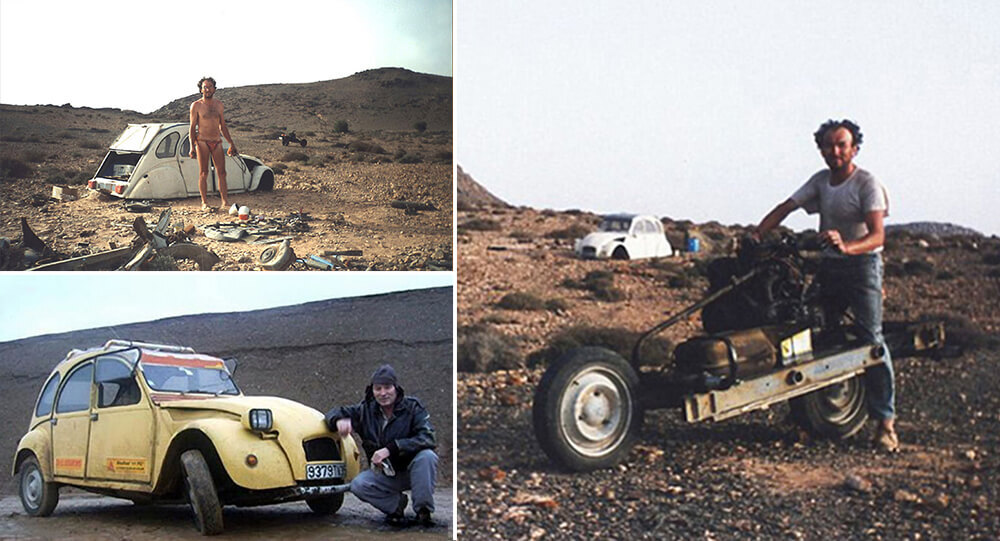
Man Trapped in the Sahara Desert Constructs a Bike From His Broken-Down Car to Save His Life
A man who became lost in the desert disassembled his broken-down car and turned it into a functional motorcycle, which he used to escape.

Timothy Ray Brown, who inspired millions of HIV-positive people, died of leukemia
Timothy Ray Brown, also known as "The Berlin Patient," was the first person to be HIV-free. He was diagnosed with leukemia in 2006 and had a bone marrow transplant in 2007 as part of his treatment. The transplant helped him overcome the otherwise incurable disease thanks to the rare, HIV-resistant donor.

ILOVEYOU Virus, the worst computer virus of all time
The ILOVEYOU Virus, also known as Love Letter for You or Love Bug, had a high infection rate due to its ability to spread itself by copying entries from users' email address books. It is a virus that was created in 2000 by a college student in Manilla, Philippines, and was recognized by the Guinness Book of World Records as the worst computer virus of all time, causing more damage than anything before it.

The Terrifying Mount St. Helens Eruption is Captured by the Robert Landsburg Photographs
Robert Landsburg, a photographer who upon realisation that he is going to die in the mount St. Helens eruption of 1980 lay down on top if his equipment to preserve the photographs he had taken of the events. Landsburg‘s body was found 17 days later, buried in ash with his film intact.

Frank Lentini, The Three-Legged Sideshow Performer
Francesco Lentini was a man with three legs, four feet, sixteen toes, and two sets of functional male genitals. He worked for the circus and lived to be 78 years old.

A woman who had been lost since she was a newborn 51 years ago was said to have been spotted
A woman who had been lost since she was a newborn for 51 years was reported to have been sighted.

The incredible story of a plane that lost its roof in mid-flight and the light signal that saved 94 lives.
On April 28, 1988, Aloha Airlines flight 243 was on the way to Honolulu from Hilo when a huge portion of the upper part of the fuselage blew off the airplane.